
What to Do When a Water Heater Fails & Floods a Home, & Why the Tank's Age Matters
Most water heaters do not announce themselves. They sit in a garage or a hallway closet doing their job quietly for years, and then one morning there is a wet baseboard, or a soaked hallway carpet, or forty gallons on the garage floor and more still coming. If that is where you are standing right now, the disorientation is normal. Nobody keeps a plan for this in their head, and the water does not wait for you to make one.
The first fifteen minutes, in order
You do not need to do everything. You need to do these things, roughly in this order, and each one is smaller than it sounds.
Shut off the water to the tank
There is a valve on the cold water line at the top of the heater, usually a lever or a round handle. Turn the lever a quarter turn so it sits across the pipe, or turn the round handle clockwise until it stops. If that valve is stuck or you cannot reach it, go to the main shutoff for the house. In most Phoenix-area homes that is near the front hose bib, in a box at the street, or on the wall where the supply line enters the garage.
Cut the power or the gas
For an electric heater, switch off the breaker labeled for the water heater at the panel. For a gas heater, turn the gas control dial on the front of the tank to OFF, and if you smell gas at any point, leave the house and call the gas utility from outside. A tank that keeps heating after it has drained can damage itself further.
Get the water moving away from what it can ruin
Move boxes, stored photos, pet food, and anything cardboard off the floor. Cardboard wicks water upward fast. If the tank is in a garage, water tends to run toward the interior door threshold, so a rolled towel there buys you time. Do not use a household vacuum on standing water.
Take photos before you clean up
Wide shots of the room, close shots of the tank, the data plate on the side, the wet flooring, and anything stored on the floor that got soaked. Insurance adjusters ask about the source and the age of the equipment. Ten photos now saves a long conversation later.
The tank's age is the single most useful fact about it
A standard glass-lined steel tank fails from the inside out. Water sits against steel, the thin glass lining develops hairline cracks, and a sacrificial anode rod (a magnesium or aluminum rod hanging inside the tank) corrodes in place of the steel. When that rod is used up, the steel starts going. Hard water speeds the whole process up, and Phoenix-area municipal water is hard, so scale builds on the bottom of the tank and traps heat against the steel there. That is why so many tanks fail at the bottom seam rather than at a fitting. There is no warning drip in a lot of these cases. The seam gives and the whole tank empties. This is also why age is the first thing an insurance adjuster looks for. A tank well past its expected service life reads as a maintenance question, not a sudden event, and that distinction can affect how a claim is handled. It is worth knowing your tank's age before anyone asks.
How to read the age off the tank
Find the data plate or sticker on the side. The serial number encodes the manufacture date, usually in the first four characters. Many brands use a two-digit year and two-digit week, so 1908 means the 8th week of 2019. Some use a letter for the month. If the format is not obvious, search the brand name plus 'serial number date code' and the manufacturer's chart will tell you.
What the years generally mean
As general industry guidance, a conventional tank heater is often considered to be in its later service years somewhere around the decade mark, and tankless units run longer. Hard water, no anode rod replacement, and no annual flushing all shorten that. A tank past its expected life that has never been flushed is the profile that fails without warning.
Signs a tank is telling you something
Rusty or metallic-smelling hot water, rumbling or popping when it heats (that is scale), a slow weep at the bottom that dries into a chalky ring, or a pan under the tank that is damp more often than not. Any of these on an older tank is worth a plumber's eyes.
What actually reduces the risk
Flushing sediment out annually, having the anode rod checked and replaced when it is spent, keeping a drain pan with a line routed to a drain, and installing an automatic leak shutoff valve. None of these are expensive relative to a flooded house.
What the water is doing while you wait
Clean water from a supply line starts out as what the restoration industry calls Category 1, which is the least contaminated kind. It does not stay that way. Once it has been sitting, moved through flooring, or crossed contaminated surfaces, it degrades, and after roughly a couple of days the assumption shifts. That is the real reason for urgency, not pressure to make a decision. Water also travels much farther than the wet spot you can see. It moves along the underside of flooring, into the bottom plates of walls, under cabinet toe kicks, and into wall cavities where drywall wicks it upward. A drywall wall that looks dry at eye level can be saturated for the first foot off the floor. Professional drying uses moisture meters and thermal imaging to find those areas, then places air movers and dehumidifiers to pull the moisture back out through the materials rather than just off the surface. Air conditioning and box fans alone do not do this; they dry the surface and leave the cavity wet, which is where mold growth starts. If the water reached drywall, baseboard, cabinetry, or subfloor, that is the point where drying equipment matters. You can read more about how that process runs on our water damage restoration page, and about what happens when materials cannot be saved on our reconstruction and rebuild page.
Talking to your insurance company without dreading it
Sudden and accidental discharge from a water heater is a common covered loss on homeowners policies, while the cost of replacing the failed heater itself often is not, and long-term seepage usually is not either. That is the general shape of it; your policy is the actual answer. When you call, you will be asked when you discovered it, what the source was, whether the water has been shut off, and what got wet. Have your photos, the tank's serial number and age, and a note of the time you found it. Keep any receipts for towels, fans, or a plumber's emergency visit. Do not throw away soaked materials until they have been documented, and do not sign anything that assigns your claim benefits away without reading it carefully. A restoration contractor can document moisture readings and drying progress in the format adjusters expect, which tends to make the claim conversation shorter for you. If you want to talk through what you are looking at before deciding anything, you can reach us through the contact page or learn who you would be dealing with on our about page.
Questions people ask us
How do I know if the water got into the walls?
Press on the drywall near the floor. If it feels soft, spongy, or leaves an impression, it has absorbed water. Baseboard that has swelled, separated from the wall, or shows a darker line along the bottom is another sign. The reliable answer comes from a moisture meter, because drywall can be saturated inside the wall cavity while the painted surface feels dry to the touch.
Can I just use fans and the air conditioning to dry it out?
For a small spill on tile that you caught immediately, often yes. For water that reached carpet pad, laminate, hardwood, drywall, or subfloor, usually no. Household fans move air across the surface but do not lower the humidity in the room, so moisture that comes out of the material has nowhere to go and reabsorbs. Drying equipment pairs air movement with dehumidification, which is what actually pulls water back out of building materials.
My water heater is in the garage. Does that mean the damage is limited?
Not necessarily. Garage slabs are usually sloped, and the water tends to find the interior door, the shared wall with the house, or the seam where the slab meets the framing. Water can travel under the wall plate into an adjoining room without ever crossing the threshold visibly. It is worth checking the flooring on the other side of any wall the garage shares with living space.
Should I replace the water heater before or after the drying work?
Replacing the heater is a plumbing job and can happen right away; drying is separate and runs on its own timeline. Just have the failed tank photographed with its data plate visible before it is hauled off, since the age and serial number often come up in the claim. Also keep the old unit's paperwork if you have it.
The standard our team works to
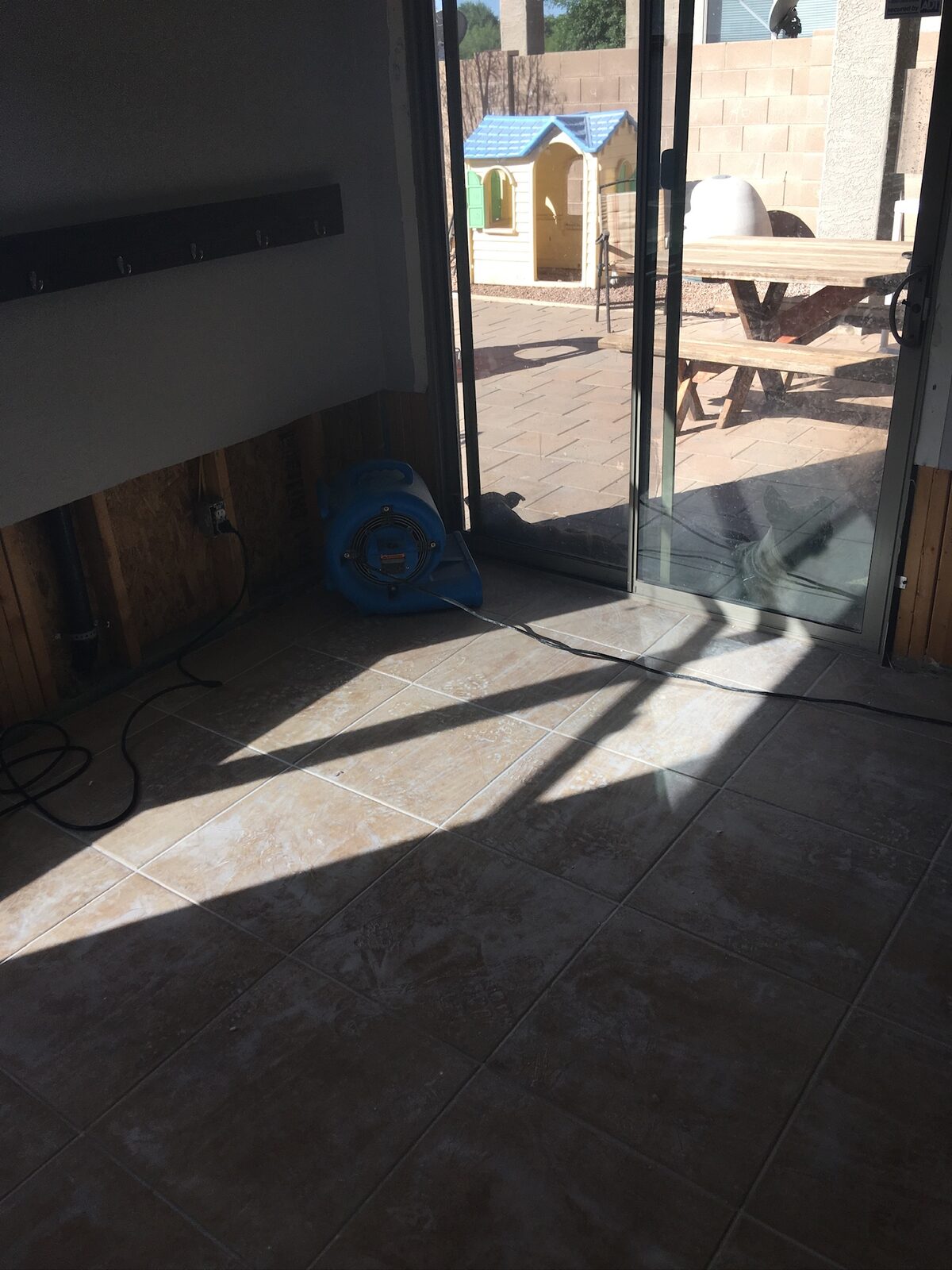
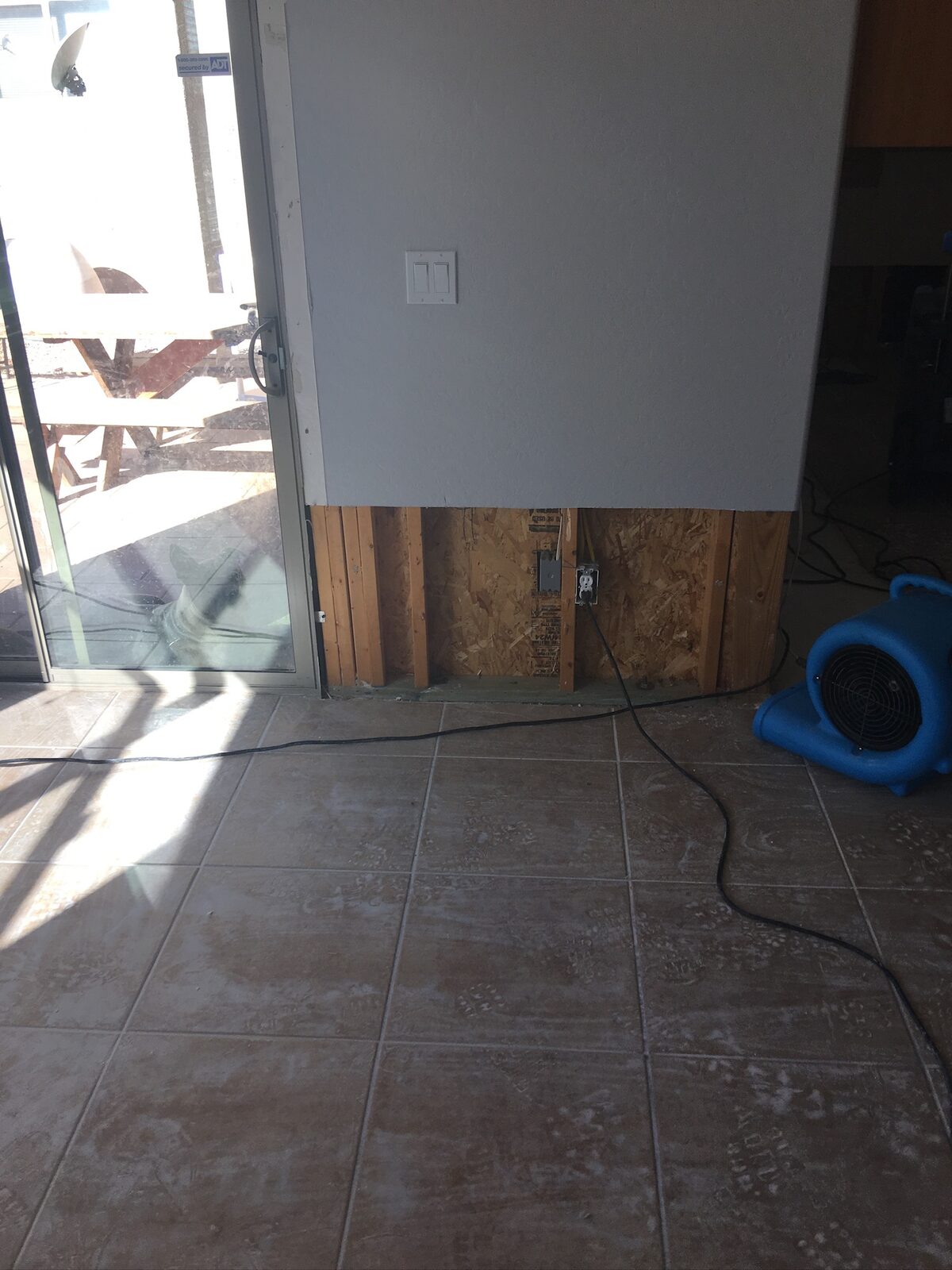
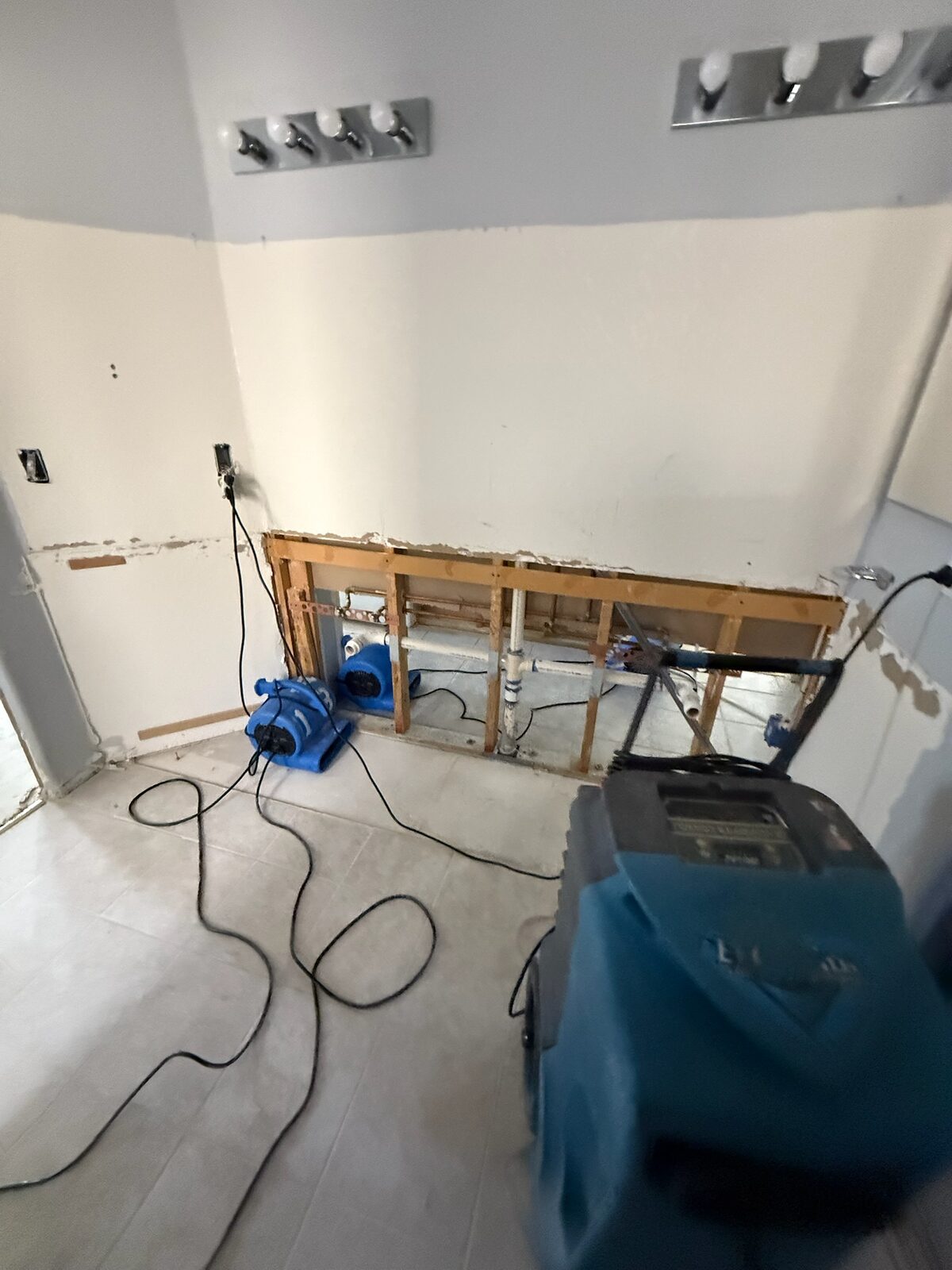
Residential reconstruction work by members of our team. See the full gallery →
More from Gold Water Fire
Abrasive Cleaning Methods for Soot on Framing and Masonry
A look at how abrasive cleaning methods remove soot from wood framing and masonry after a fire, and when each method fits the material.
AC Condensate Line Clogs & the Water Damage They Cause in Phoenix Homes
Why Phoenix AC condensate lines clog every summer, what the water damage looks like, and how to find the source before the ceiling stain spreads again.
Actual Cash Value vs Replacement Cost: Why Your Check Might Not Match the Repair Bill
Confused why your insurance check seems short after fire or water damage? Learn the difference between actual cash value and replacement cost coverage.
If you want a second set of eyes on it
You do not have to have decided anything yet. If you want to describe what you are seeing and get a straight answer about whether it needs drying equipment, call Gold Water Fire at (480) 999-3339 or email Help@goldwaterfire.com. We work throughout the Phoenix metro area, from Peoria and Avondale out to Queen Creek, San Tan Valley, and Apache Junction.
Call (480) 999-3339