
Washing Machine Supply Line Failures, Why They Happen & What to Check Before They Do
Maybe it was a damp baseboard you wiped up and forgot about. Maybe the laundry room floor felt cool underfoot one morning and dry the next. Maybe nothing has happened yet at all, and you just have a low, unspecific worry about the two rubber hoses behind a machine you have never once pulled away from the wall. That worry is worth sitting with, because it is usually pointing at something real. The hoses behind a washing machine are under pressure every hour of every day, whether the machine is running or not, and almost nobody looks at them until the moment they stop holding. If you have been circling this without quite naming it, you are not being paranoid. You are noticing the one part of a house that is designed to fail quietly and then all at once.
What is actually happening back there
A standard washing machine connection has two supply lines, hot and cold, running from wall valves to the back of the machine. Unless the valves are closed, both lines hold full household water pressure continuously, commonly somewhere in the range of normal municipal supply pressure. The machine's inlet solenoid opens and closes each cycle, and every time it snaps shut it sends a small shock back up the line. Over years, that repeated pressure spike works on the weakest point in the assembly. Rubber supply hoses age from the inside out. The inner liner hardens, loses elasticity, and develops fine cracks that you cannot see from the outside. The braided or reinforced outer layer holds for a while after the liner has given up, which is why a hose can look perfectly fine right up until it splits. Failure is rarely a slow drip that warns you. It is often a longitudinal split or a blown coupling, and at full pressure an open line can move a large volume of water in a very short time. The reason this specific failure causes so much damage is timing. It does not need the machine to be running, and it does not care whether anyone is home. A line that lets go on a Friday evening while the family is out of town has the whole weekend to work.
Why these lines fail, and what makes it worse in Arizona homes
Age is the main driver, but several conditions accelerate it, and a few of them are common across Phoenix metro houses. High static pressure. Some neighborhoods and some hillside or newer-development areas run higher supply pressure than a rubber hose is happy living with long term. A pressure regulator on the main can drift or fail without anyone noticing, and the first thing to complain is usually the weakest hose in the house. Hard water and mineral scale. Valley water carries a lot of dissolved mineral. Scale builds inside the inlet screens and around the coupling threads, which restricts flow, raises turbulence at the fitting, and encourages corrosion where a brass coupling meets a rubber ferrule. Heat. A laundry room in a garage, or a closet that backs onto a west-facing wall, cycles through real temperature swings all summer. Rubber cures and stiffens faster in that environment than it does in a conditioned interior room. Mechanical strain. Machines walk during spin cycles. If the hose is stretched tight, kinked against the wall, or bent sharply right at the coupling because the machine sits too close, that bend becomes the failure point. Overtightened couplings are the other side of the same problem, since a crushed washer or a cracked plastic elbow will weep long before it blows. The valves themselves. Multi-turn gate valves at the wall seize with scale and stop closing fully. People discover this at the worst possible moment, when they are trying to shut the water off and the handle spins without doing anything.
What to check before it fails
Pull the machine out far enough to see behind it, with a flashlight, and give yourself ten minutes. Look at the hose body for blistering, bulging, surface cracking, or a spot that looks swollen or shiny compared to the rest. Run a hand along both lines and feel for stiffness, or for a hose that has gone hard and will not flex. Check the last two inches at each end, right where the hose enters the metal coupling, because that is where most splits start. Look for rust or a white or green crust at the couplings. Any mineral crust means water has been escaping, even slowly. Feel the drywall and the baseboard behind the machine, and look at the floor under the front feet for staining, cupping, or a chalky ring that means water evaporated there before. Check the geometry. There should be a gentle curve in each hose, not a tight bend, not a stretched straight line. The machine should sit far enough from the wall that the hose is not pressed against it. Test the shutoff valves. Close them and open them again. If a handle is stiff, seized, or will not stop the flow, that is a plumbing repair worth doing now rather than during an emergency. A single-lever laundry box that closes both lines at once is easier to use and therefore actually gets used. Check the date. Many hoses have a manufacture date stamped on the sleeve. Rubber hoses have a limited service life and most manufacturers publish a recommended replacement interval, so if you cannot find a date at all, the hose is probably old enough to be worth replacing on principle. One habit matters more than any inspection: close the valves when you leave town. It costs nothing and it takes the whole scenario off the table.
What water does after the line lets go
If you are reading this after a failure rather than before it, the sequence is worth understanding, because what you can see is usually a fraction of what is wet. Water from a laundry room runs along the flattest path it can find, which in most Valley homes means the slab, and it wicks upward into anything porous it touches. Drywall pulls water vertically well above the visible line. Baseboards, door casings, and the bottom plate of a wall stay saturated long after the floor surface looks dry. Under laminate or engineered flooring, water can travel several rooms away and sit there with nowhere to evaporate. Because supply-line water is clean when it leaves the hose, people often assume it is harmless and let it dry on its own. The problem is time, not contamination. Warm, dark, enclosed cavities that stay damp for a couple of days start growing things, and the drying window is shorter than most people expect. Fans pointed at a wet floor move surface air, but they do not pull water out of a wall cavity or from under a cabinet toe kick. That takes measurement first, moisture readings across the affected area to map how far it actually went, then containment and controlled drying of the specific assemblies that are wet. If the water sat long enough that drywall is soft, cabinets have swelled, or flooring has lifted, the work moves past drying and into repair. Our water damage restoration page walks through how mitigation is approached, and reconstruction and rebuild covers putting the room back together once everything is dry.
Questions people ask us
How often should washing machine hoses be replaced?
Rubber supply hoses have a finite service life, and hose manufacturers generally print a recommended replacement interval on the packaging or the sleeve. If you do not know how old a hose is, that itself is a good reason to replace it. Stainless braided hoses last longer than plain rubber but are not permanent, since the rubber liner inside the braid still ages and the couplings still corrode.
Are stainless steel braided hoses actually better?
They resist abrasion and burst failure better than bare rubber, which is why they are the common recommendation. But the braid is a jacket over a rubber core, so the core still hardens with age and heat, and the crimped fittings can still corrode or leak. Braided hoses should be inspected on the same schedule as any other hose, not treated as install-and-forget.
Should I shut the water off to the washer between loads?
Closing the valves after every load is the safest habit and is what a lot of plumbers do in their own homes, though frequent operation of an old multi-turn valve can make it weep. At minimum, close them any time the house will be empty for more than a day. A single-lever laundry shutoff box makes this practical enough that people actually keep doing it.
The floor looked dry the next day. Do I still need someone to look at it?
A dry surface says very little about what is inside the wall or under the flooring. Moisture meters and thermal imaging show how far water traveled, and that boundary is usually well beyond the wet spot you saw. If you want it checked, you can reach Gold Water Fire at (480) 999-3339 or through the contact page.
The standard our team works to
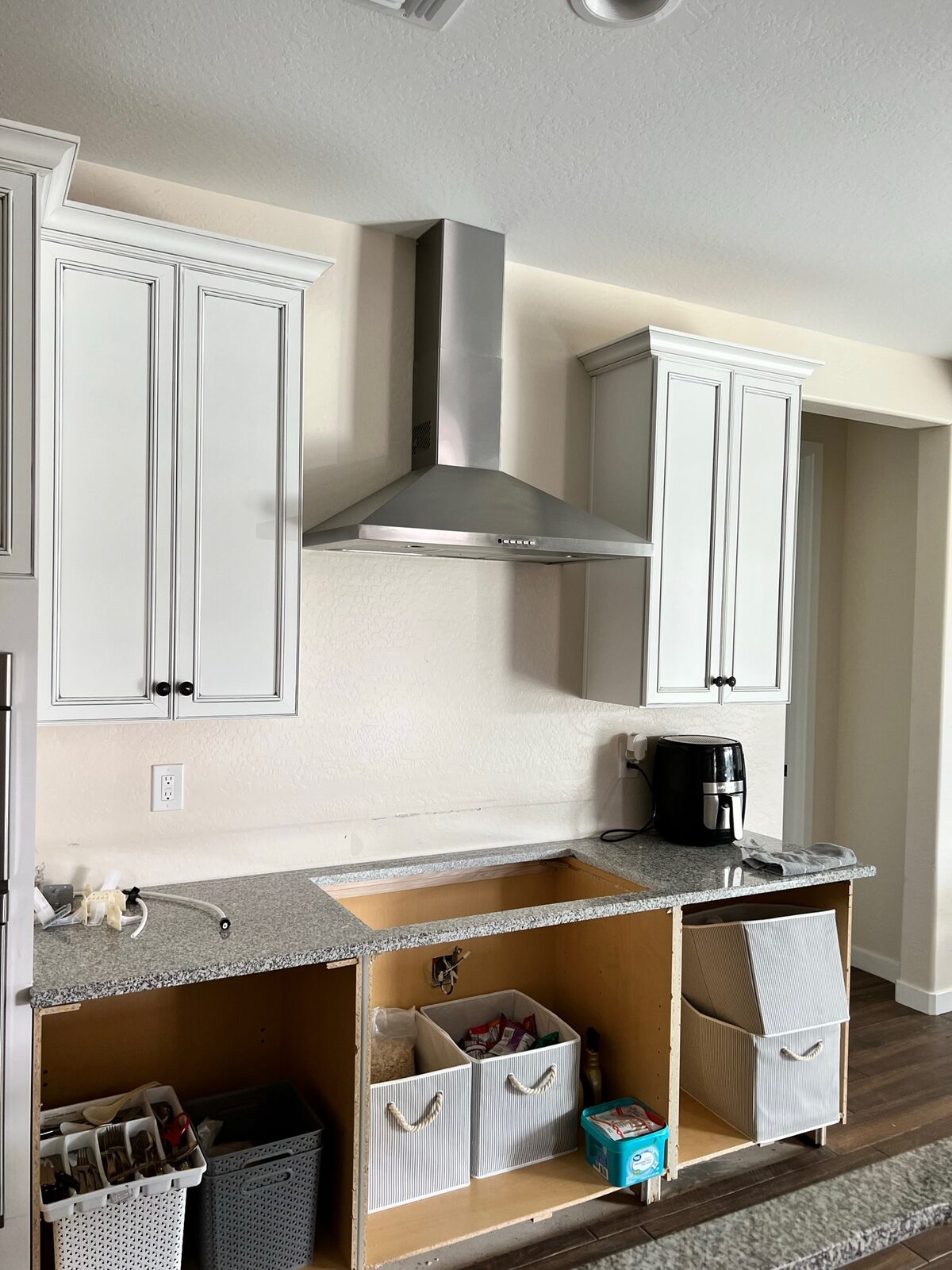
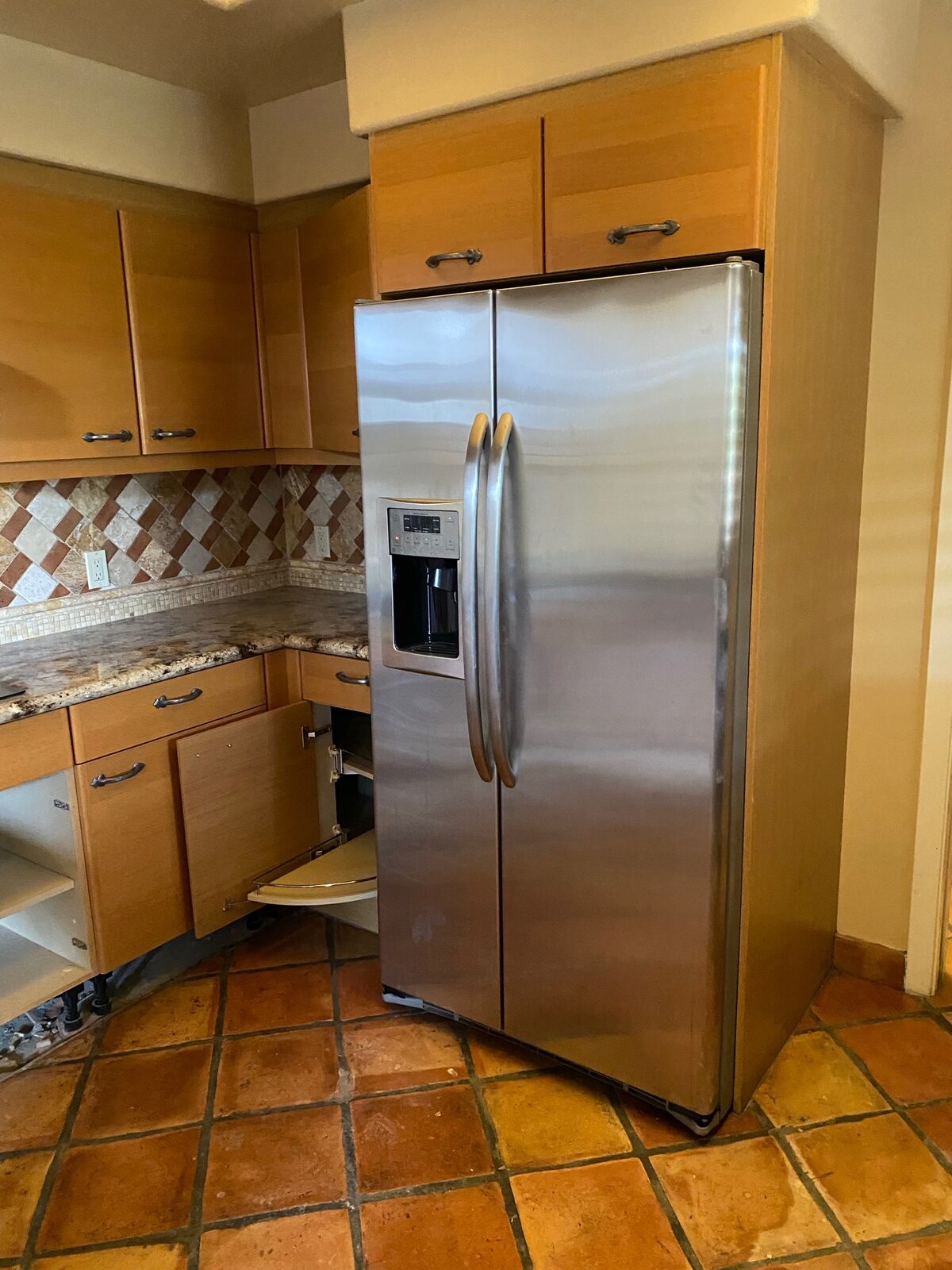
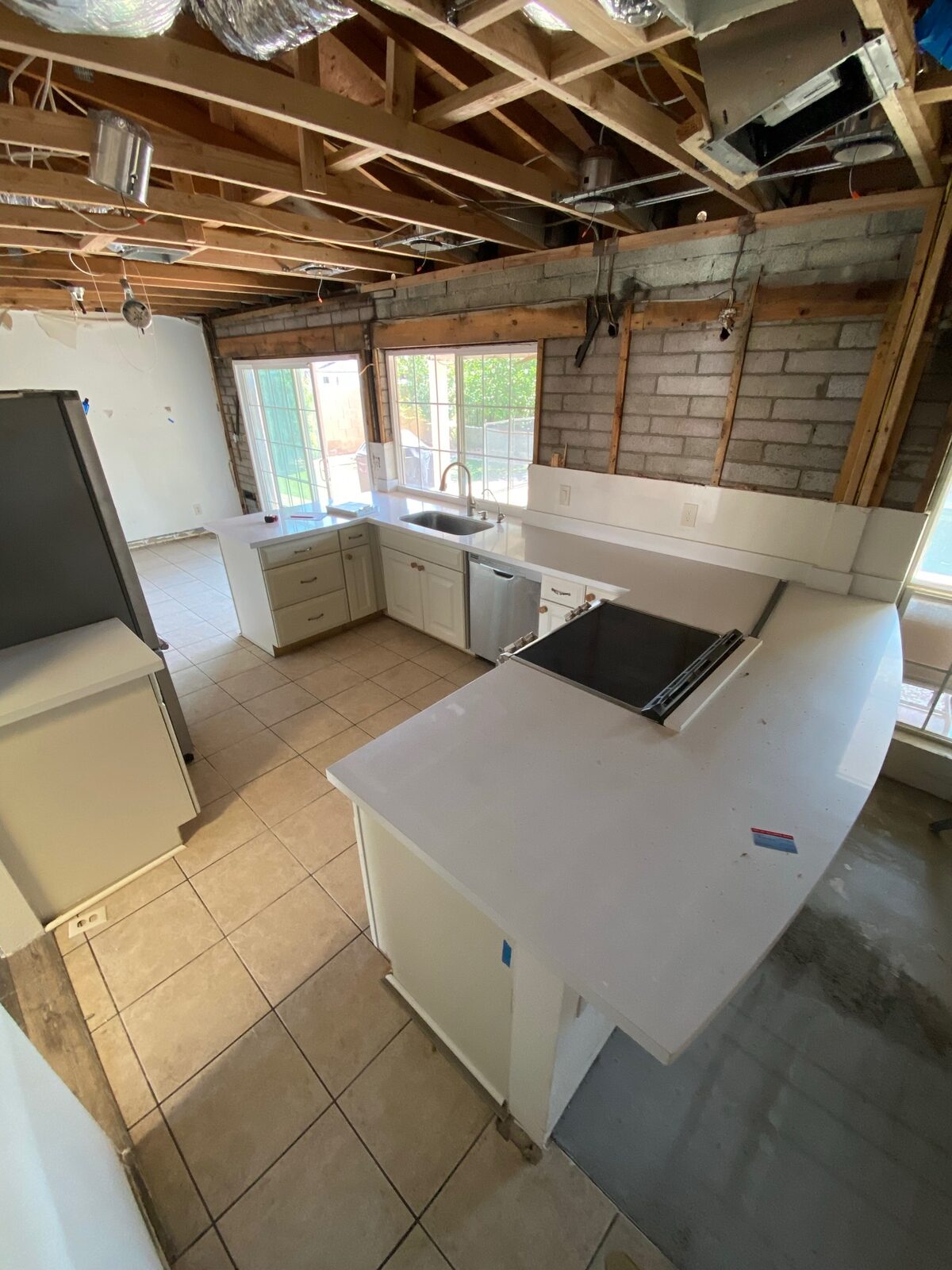
Residential reconstruction work by members of our team. See the full gallery →
More from Gold Water Fire
Abrasive Cleaning Methods for Soot on Framing and Masonry
A look at how abrasive cleaning methods remove soot from wood framing and masonry after a fire, and when each method fits the material.
AC Condensate Line Clogs & the Water Damage They Cause in Phoenix Homes
Why Phoenix AC condensate lines clog every summer, what the water damage looks like, and how to find the source before the ceiling stain spreads again.
Actual Cash Value vs Replacement Cost: Why Your Check Might Not Match the Repair Bill
Confused why your insurance check seems short after fire or water damage? Learn the difference between actual cash value and replacement cost coverage.
If something behind the washer has been bothering you
Whether the line already let go or you just want someone to read the moisture in a wall you are not sure about, Gold Water Fire works throughout the Phoenix metro area, from Peoria and Avondale out to Queen Creek, San Tan Valley, and Apache Junction. Call (480) 999-3339 or email Help@goldwaterfire.com. AZ ROC #264344 KB-2.
Call (480) 999-3339Water Damage Restoration · Reconstruction & Rebuild · Contact Gold Water Fire · About Our Team