
When Pool Equipment & Plumbing Leaks Find Their Way Into the House
You have mopped that corner of the hallway three times now. The tile by the back wall goes dark, then dries, then goes dark again a week later, and there is no pipe above it, no appliance near it, nothing inside the house that explains it. Maybe you have noticed the pool dropping faster than the summer should account for, and you filed that away as a separate annoyance. It is unsettling to keep fixing something you cannot name. Most people in this spot start to doubt their own eyes, wondering if the floor was always like that, if the smell in the closet is new or if they just started paying attention. It usually is not your imagination. Water that comes from outside a house behaves differently than water from inside it, and that difference is exactly why it takes so long to see.
When Pool Equipment & Plumbing Leaks Find Their Way Into the House
A pool leak does not act like a burst pipe
When a supply line breaks inside a wall, you get a fast, loud, obvious problem. A pool system leak is the opposite. It is slow, it is outdoors, and it moves through soil before it ever touches your house, so by the time you notice anything the water has been traveling for weeks or months. In the Phoenix valley, that travel path is shaped by things nobody thinks about until it matters: post-tension and slab-on-grade foundations sitting close to grade, caliche layers that stop water from percolating down and push it sideways instead, and yards graded so the equipment pad sits at or above the level of the back patio. Water leaving a cracked pump housing or a failed underground return line does not soak straight down. It hits a hard layer, spreads flat, and follows the easiest route, which is often the loose backfill trench that runs alongside your foundation, or the gravel bed under the patio slab. That is why the damp spot inside the house can be twenty or thirty feet from the actual leak, and why it looks like it comes from nowhere.
The parts of a pool system that most often fail
Knowing what fails narrows the search considerably. Most pool-related water intrusion traces back to one of a handful of components, and several of them give warning signs long before anything shows up indoors.
Pump seals and the equipment pad
The mechanical seal behind the pump impeller is a wear part. When it goes, water weeps from under the motor and onto the pad, usually leaving a mineral crust or a permanently dark patch of concrete. A pad that is never fully dry, or a small channel of algae growing off one edge, is telling you something. If the pad slopes toward the house rather than away, that weeping water has a direct route to your foundation.
Filter housings and valve unions
Cartridge and DE filter tanks fail at the band clamp gasket. Multiport valves leak at the spider gasket and out the waste line. Threaded PVC unions crack over time from heat cycling and over-tightening. These leaks often only show when the pump is running, so they can be invisible during a casual daytime look and steady for eight hours overnight when the pump is on a timer.
Underground suction and return lines
The buried PVC running between the pool and the pad can crack from ground movement, root pressure, or an old repair fitting letting go. This is the hardest one to spot because nothing is visible. Symptoms include a pool that loses more water when the pump runs than when it is off, a soft or sunken strip of yard following the pipe route, and grass that stays green in a line during a heat wave.
Autofill lines, backwash lines and hose bibs
The autofill valve is fed by a house water line, so a stuck float or a cracked feed line leaks treated water continuously and the pool level never drops to tip you off. Backwash lines that terminate too close to the house dump hundreds of gallons against the foundation every time you clean the filter. Hose bibs and irrigation manifolds mounted on the same wall add to the same soil.
Reading the signs on the inside wall
Water arriving from outside almost always enters low and works upward, which produces a specific pattern. Look for dark or discolored baseboard along the bottom quarter inch first, paint that bubbles in a band a few inches off the floor, or drywall that feels soft and slightly cool when you press it near the base. Tile grout at the perimeter of a room may darken and stay darker than the rest. Carpet tack strips rust and stain the carpet edge a brown line. Wood flooring cups, meaning the edges of each board rise higher than the center, because the underside is absorbing moisture the top side is not. Baseboards may pull slightly away from the wall as the material behind them swells. An earthy, musty smell that is strongest in a closet or against one exterior wall is often the first thing a family notices, and it usually means moisture has been present long enough for microbial growth to begin. Efflorescence, a white chalky powder on the bottom of a block wall or on exposed slab edge in the garage, is a sign that water has been passing through masonry and leaving minerals behind. None of these prove a pool leak on their own, but when they all sit on the same wall, and that wall is the one facing the equipment pad, that is not a coincidence.
Tests you can run yourself before anyone comes out
You can gather a lot of useful information in a weekend without any special tools. Start with a bucket test to confirm whether the pool is actually losing water beyond evaporation: fill a five gallon bucket with pool water, set it on a step so it is partially submerged, mark the water level inside the bucket and outside on the pool wall, then compare after 24 hours with the pump on a normal schedule. If the pool drops more than the bucket, you have a leak. Repeat with the pump off for 24 hours. More loss with the pump running points toward the pressure side, meaning return lines or the equipment after the pump. More loss with the pump off points toward the suction side or the pool shell itself. Second, shut off the autofill at its valve for a full day so it cannot mask a loss. Third, walk the yard barefoot early in the morning and note any ground that is soft, spongy, or cooler than the soil around it. Fourth, look at where your backwash line discharges and where the pad drains. If either sends water within a few feet of the foundation, that alone can explain interior moisture even without a broken pipe. Write down what you find and when, because the timeline matters as much as the symptom. One caution: do not assume that stopping the leak dries the house. Soil and slab hold water for a long time after the source is gone, and material behind a wall can stay wet for weeks while the surface looks fine. Confirming the structure is actually dry, not just dry on the outside, is a separate job from fixing the pipe. That is the part covered under water damage restoration, and when drywall, baseboard, insulation or flooring has to come out and go back in, the repair side falls under reconstruction and rebuild.
Questions people ask us
Does homeowners insurance cover water damage from a pool leak?
It depends heavily on the policy and on what failed. Many policies treat sudden and accidental water discharge differently from long-term seepage, and damage that developed gradually over months is often handled differently than a pipe that broke on a specific day. Coverage for the pool equipment itself is also usually separate from coverage for the interior damage the water caused. Document the timeline, keep photos, and ask your carrier directly rather than assuming either way.
How do I know if the water in my wall came from the pool or from a plumbing leak inside the house?
The pattern is the biggest clue. Interior supply and drain leaks generally start high or mid-wall and run down, and they tend to cluster near kitchens, baths and laundry. Exterior water intrusion starts at the floor and moves up, usually along a wall that faces the yard or the equipment pad, and it often affects a long stretch of baseboard rather than one concentrated spot. Water chemistry can also help, since pool water carries chlorine and dissolved minerals that clean water does not.
The pool leak is fixed but the floor still smells. Why?
Because the source and the damage are two different problems. Concrete, soil, insulation, framing and the back side of drywall all store moisture, and they release it slowly. A room can feel dry to the touch while materials inside the wall cavity are still saturated enough to support mold growth. Odor that persists after the plumbing repair usually means moisture is still trapped somewhere and needs to be measured and dried, not just aired out.
Can slow pool leak water actually hurt the foundation?
Chronically wet soil under and beside a slab can shift, and repeated wetting and drying cycles move expansive soils in ways that stress a foundation. It also carries moisture through concrete into the framing and finishes above it. This is why a leak that seems minor because the pool only drops an inch a week is still worth taking seriously once water is reaching the house.
The standard our team works to
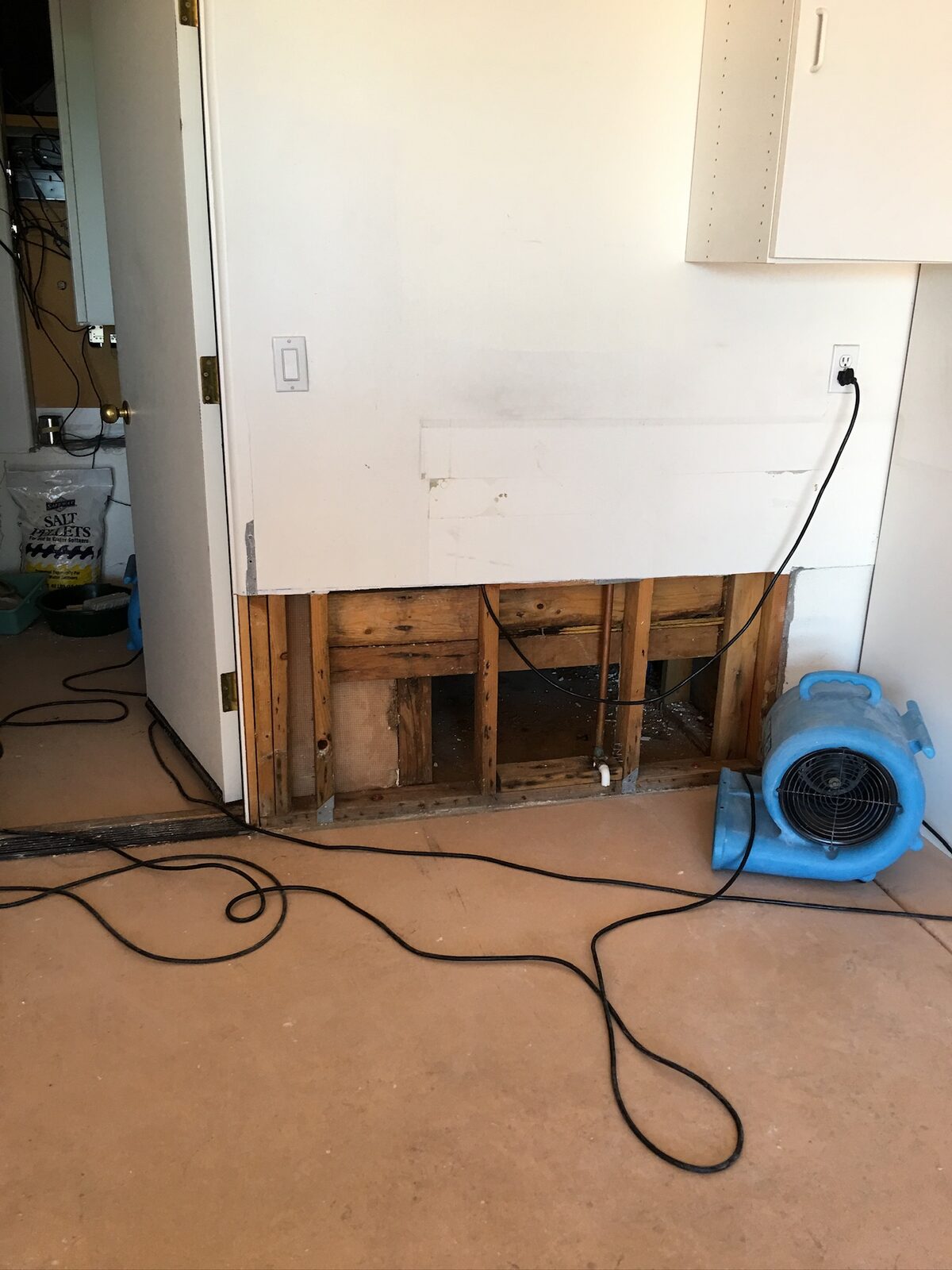
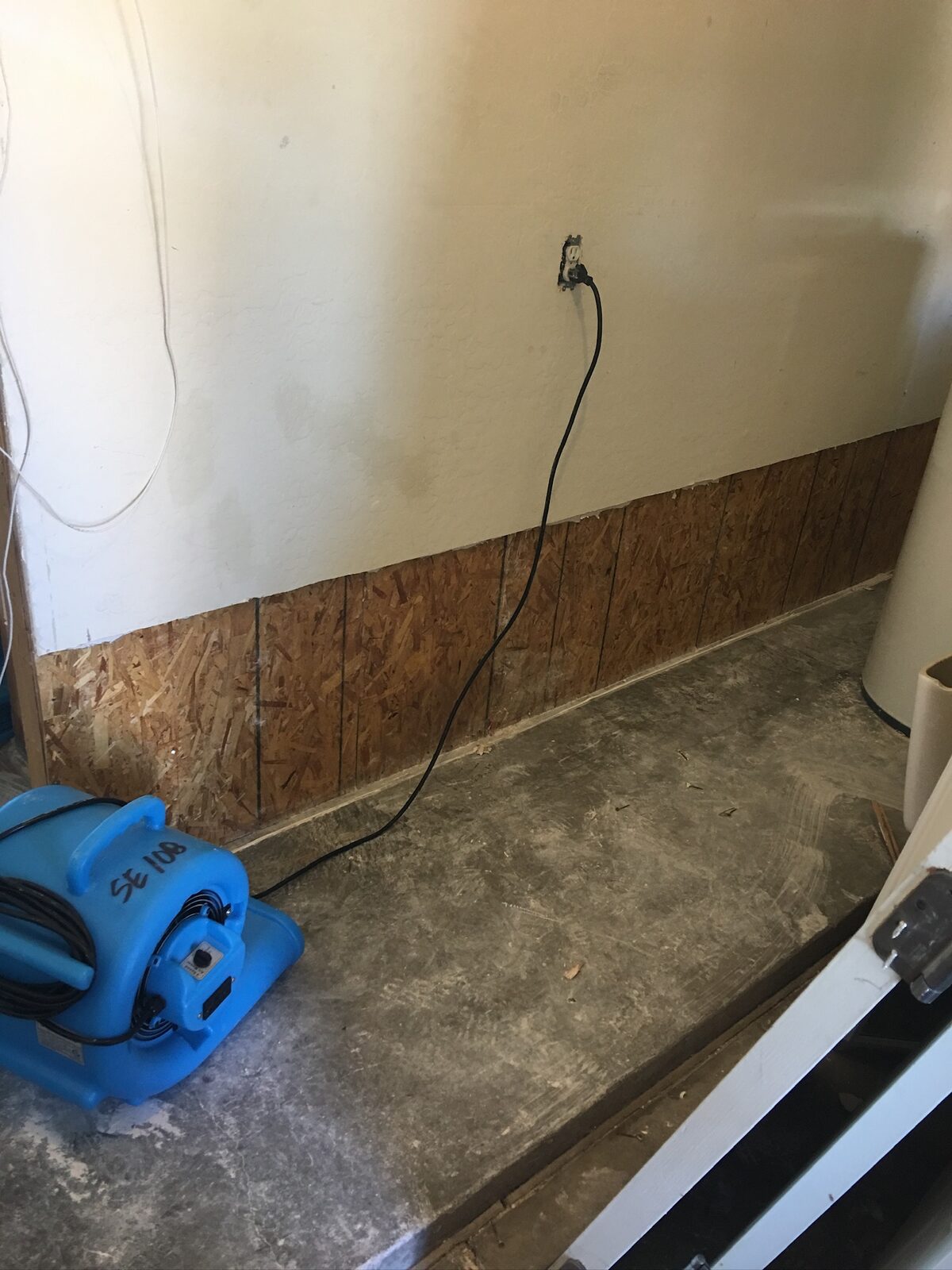
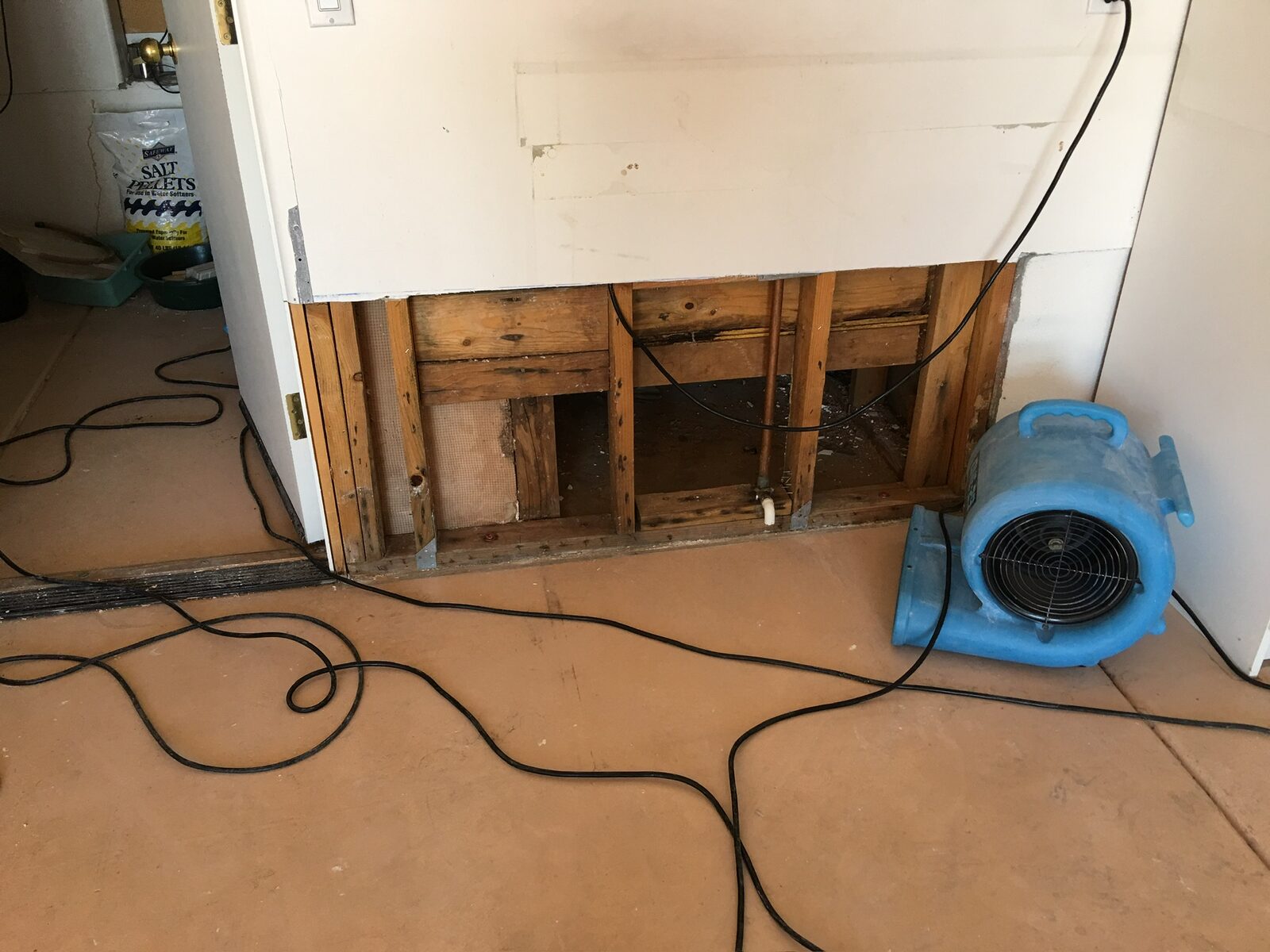
Residential reconstruction work by members of our team. See the full gallery →
More from Gold Water Fire
Abrasive Cleaning Methods for Soot on Framing and Masonry
A look at how abrasive cleaning methods remove soot from wood framing and masonry after a fire, and when each method fits the material.
AC Condensate Line Clogs & the Water Damage They Cause in Phoenix Homes
Why Phoenix AC condensate lines clog every summer, what the water damage looks like, and how to find the source before the ceiling stain spreads again.
Actual Cash Value vs Replacement Cost: Why Your Check Might Not Match the Repair Bill
Confused why your insurance check seems short after fire or water damage? Learn the difference between actual cash value and replacement cost coverage.
If the wall is wet and you still cannot say why
Take your time with the tests above, and if the answer still will not come, or if the drywall and baseboard have already gone soft, Gold Water Fire can look at the interior side of it with you. Call (480) 999-3339 or email Help@goldwaterfire.com. We work throughout the Phoenix metro area, from Peoria and Avondale out to Queen Creek, San Tan Valley and Apache Junction. AZ ROC #264344, KB-2.
Call (480) 999-3339Water Damage Restoration · Reconstruction & Rebuild · Fire Damage Restoration · About Gold Water Fire · Contact Us