
Dishwasher Leaks & the Hidden Damage They Cause Under Cabinets and Flooring
You have been noticing something for a while now, and you still cannot say exactly what it is. The floor by the dishwasher gives a little when you stand there. The cabinet under the sink smells faintly of something old and damp, even after you cleaned it. A seam in the vinyl has lifted, and you keep telling yourself it was always like that. Nothing has flooded. There is no puddle to point at. And that is the part that wears on you, because a problem you cannot see is a problem you cannot decide about. You have been standing in your own kitchen wondering whether you are imagining it, and no one has been able to tell you otherwise.
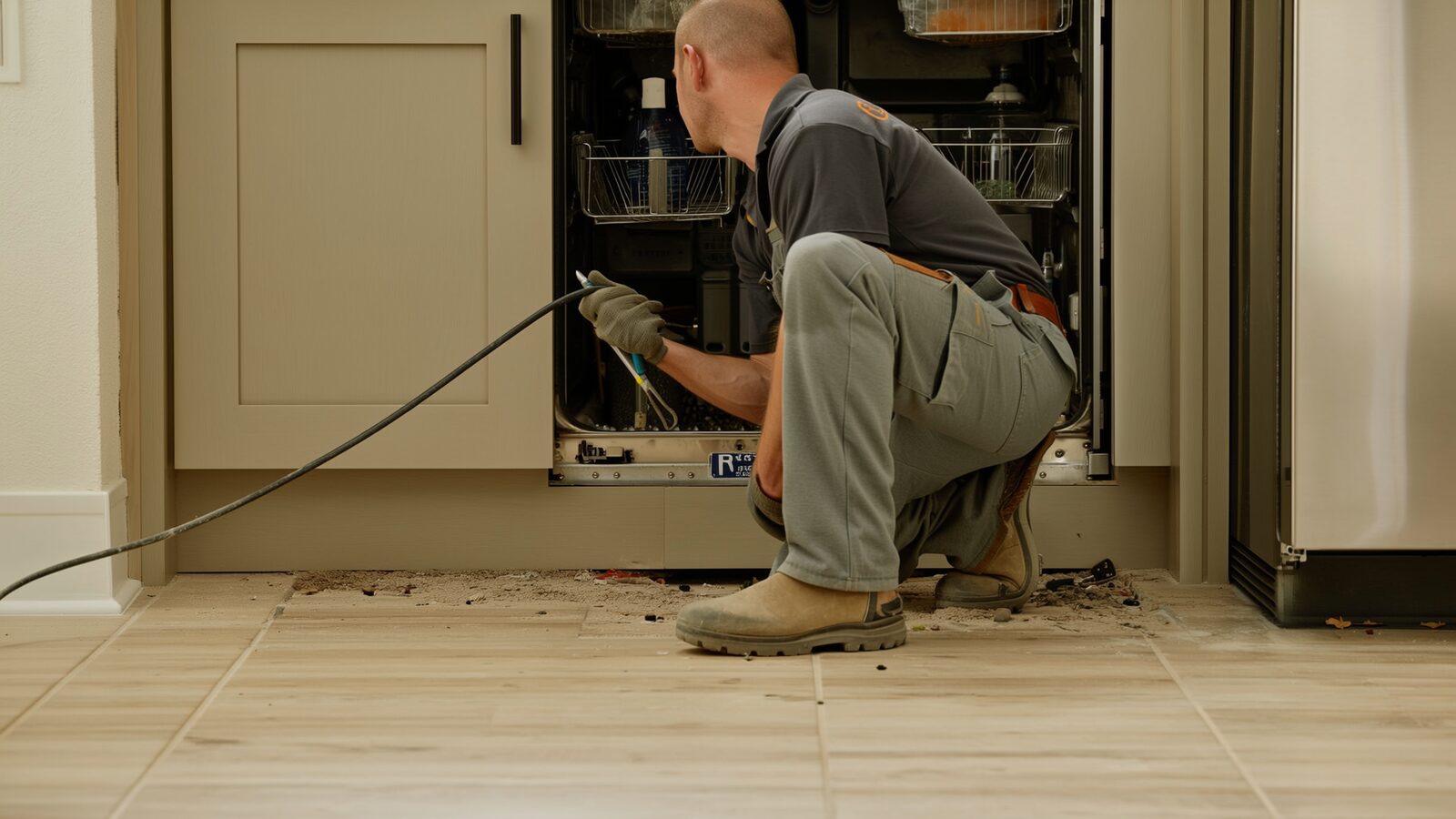
Dishwasher Leaks & the Hidden Damage They Cause Under Cabinets and Flooring
A dishwasher leak almost never shows up where the water is
A dishwasher sits in a boxed opening between cabinets, on top of the same subfloor as everything else in the kitchen, with a toe-kick panel closing off the front. Water that escapes a door gasket, a hose clamp, a pump seal or the drain line does not run out onto the floor where you would see it. It runs backward and down, into the cavity under the unit, and then it spreads along the path of least resistance: under the adjacent cabinet bases, along the subfloor seams, and out toward the flooring underlayment. That cavity is the worst possible place for water to sit. It is dark, it has almost no airflow, and it is lined with materials that absorb readily. Cabinet boxes are usually particleboard or MDF with a finished face and raw, unsealed bottom edges. Those raw edges wick moisture upward like a sponge. Meanwhile the leak is often intermittent, only during a wash cycle, only on the heavy setting, only when the door seal compresses a certain way, so the amount of water at any one moment is small enough that nothing ever pools where a person would notice it. The damage is not caused by volume. It is caused by time.
The early signs, in the order most people actually notice them
Most homeowners do not discover a dishwasher leak. They discover a symptom and misattribute it for months. These are the signs worth taking seriously, roughly in the order they tend to appear:
A smell you keep re-cleaning
A musty or sour odor near the dishwasher or the sink cabinet that comes back a few days after you wipe everything down. Odor is a byproduct of organic growth on damp material, and the material is usually behind or beneath what you can reach to clean.
Flooring that changed at one seam
Vinyl plank lifting or cupping at a single joint. Laminate edges that feel slightly swollen or rough where they used to be smooth. Tile grout that darkened in one line. Hardwood that has crowned or cupped in a narrow band running away from the appliance.
The toe kick and cabinet base
Run a finger along the bottom front edge of the cabinet next to the dishwasher. Softness, a chalky texture, bubbled or peeling veneer, or a visible dark line along the bottom inch are all signs the particleboard has been absorbing moisture. Check the underside of the sink base floor too, not just the visible top.
Sound and give underfoot
A spot of floor in front of or beside the dishwasher that flexes, creaks or feels slightly hollow compared to the rest of the kitchen. That usually means the subfloor beneath has lost structural integrity, which takes sustained moisture, not a one-time spill.
How to check it yourself without tearing your kitchen apart
You can learn a lot in twenty minutes with a flashlight and a phone camera. Start by pulling the toe-kick panel off the front of the dishwasher. On most units it is held by two screws at the bottom, sometimes just clipped in. Look at the floor underneath with the flashlight held low and sideways, so the light rakes across the surface. Mineral staining, a whitish crust, rust on the leveling feet or the frame, warped or delaminating subfloor, and any dampness are all meaningful. Take a photo, because the light angle catches things your eye skips. Next, run a normal cycle and check again mid-wash and right after the drain. Feel along the drain hose where it enters the cabinet and where it clamps to the disposal or standpipe, and check the water supply line fitting at the back. Then open the sink cabinet and press firmly on the cabinet floor near the back corners with your thumb. If it depresses, softens, or feels spongy, moisture has been in that panel for a while. A few practical cautions. Do not assume that a dry surface means dry material, because particleboard and subfloor plywood can hold moisture well past the point where the top feels dry to the touch. Do not run the dishwasher again until you know where the water is coming from, if you have found active wetness. And resist the urge to seal or caulk over a stained area, because covering a wet cavity traps the moisture and accelerates what is happening underneath. If you find standing water or the flooring has already moved, shut the supply valve under the sink and stop there. What matters next is finding the full extent of the wet material, not just the spot you can see. Our overview of water damage restoration walks through how that assessment works.
Why drying is only half the question
There is a hard truth in slow leaks that fast floods do not have. With a burst supply line, everything is soaked at once and everything gets dried at once. With a leak that ran under a dishwasher for months, the water has already changed the materials. Swollen particleboard does not return to its original dimension when it dries. Delaminated subfloor does not re-bond. Cupped hardwood may flatten partially or may not. Drying stops the damage from continuing, which is essential and time-sensitive, but it does not undo what already happened to the wood. That is why kitchens with hidden leaks often become two separate conversations: getting the cavity and the structure genuinely dry and stable first, then deciding what has to be rebuilt. Cabinet bases, a section of subfloor, toe kicks, sometimes the flooring across the whole run so it matches. Gold Water Fire handles both sides of that in Phoenix, Mesa, Chandler, Gilbert, Scottsdale, Tempe, Glendale, Peoria, Queen Creek and the surrounding metro, so the drying work and the reconstruction and rebuild are not two unrelated projects you have to coordinate yourself. You can read more about the team or get in touch when you are ready to have someone look at it.
Questions people ask us
How long can a dishwasher leak go unnoticed?
There is no fixed answer, and that is the difficult part. A leak that only releases a small amount of water during part of a wash cycle can continue for a long stretch without ever showing a puddle, because the water is absorbed by cabinet material and subfloor as fast as it arrives. Most people notice a smell, a soft spot or a lifted flooring seam long before they notice water. Those symptoms are the leak, just arriving late.
The floor is dry now. Does that mean the problem is over?
Not necessarily. Surface dryness and material dryness are different things. Particleboard cabinet bases, plywood subfloor and the underside of flooring can hold significant moisture while the visible surface feels completely dry, especially in a closed cavity with no airflow. Moisture readings taken in the material itself are what tell you whether it is actually dry.
Do I have to replace the cabinets if water got under them?
It depends on what the cabinet boxes are made of and how long they were wet. Solid plywood boxes with a sealed finish often survive. Particleboard and MDF bases that swelled, softened or crumbled at the bottom edge generally do not recover, because the material expands permanently once the fibers absorb water. Often only the base and toe kick need replacement rather than the full cabinet run, but that is a judgment made after everything is dry.
Should I run the dishwasher while I figure this out?
If you have found active wetness or a soft spot, no. Every cycle adds more water to a cavity that is already saturated and cannot dry on its own. Shut off the supply valve under the sink, leave the toe kick off so the area gets some air, and get the source identified before you use the appliance again.
The standard our team works to
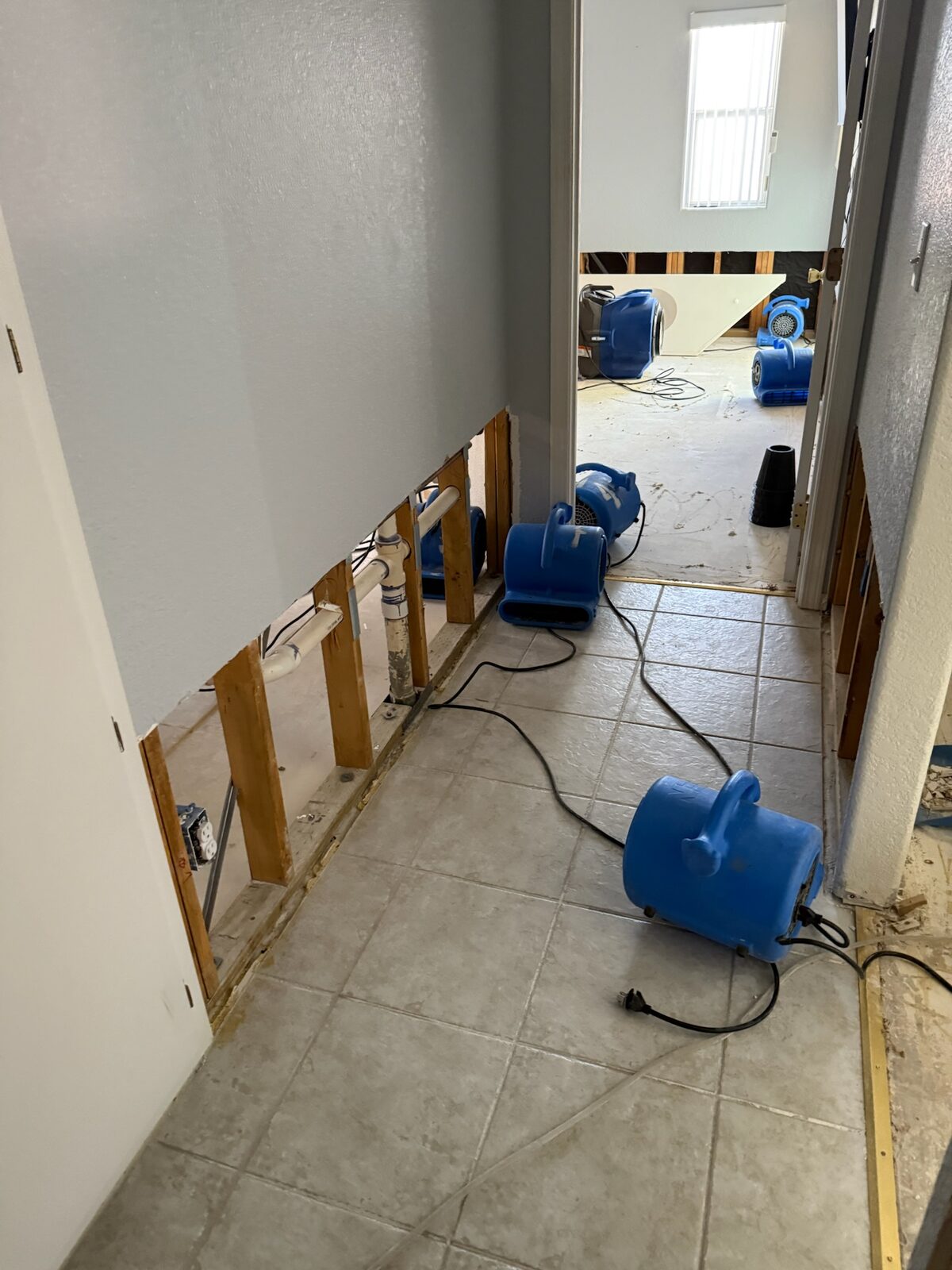
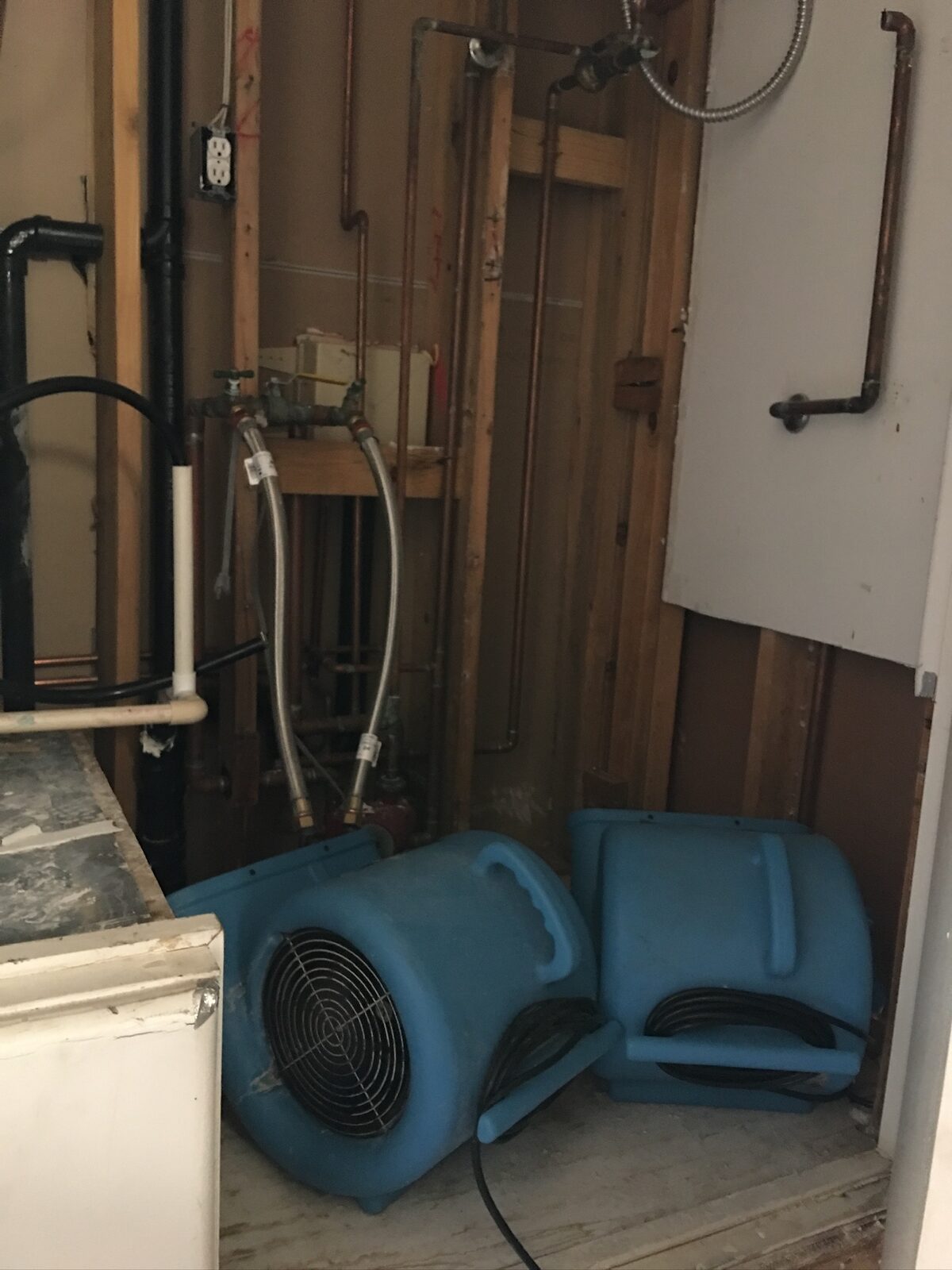
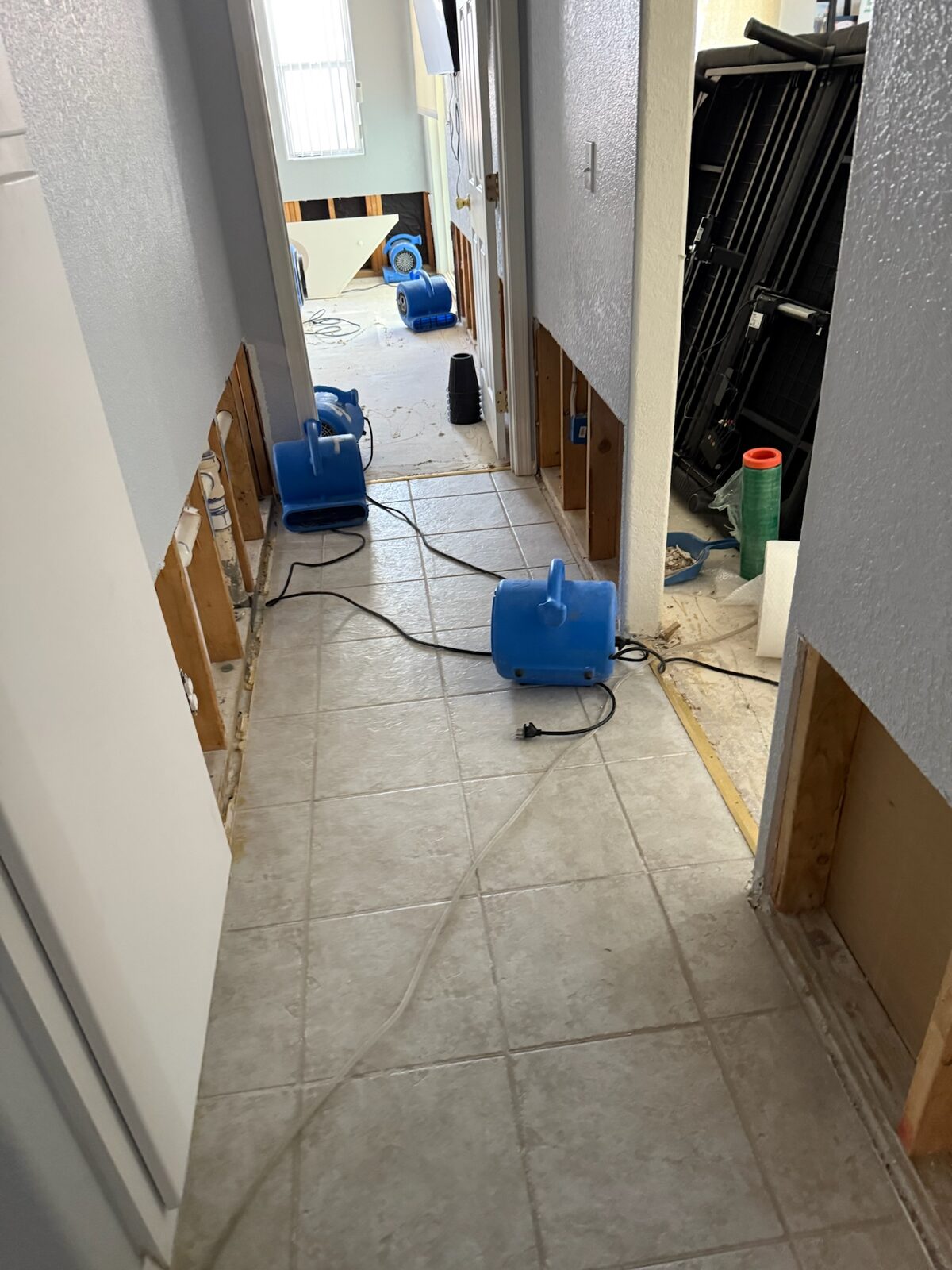
Residential reconstruction work by members of our team. See the full gallery →
More from Gold Water Fire
Abrasive Cleaning Methods for Soot on Framing and Masonry
A look at how abrasive cleaning methods remove soot from wood framing and masonry after a fire, and when each method fits the material.
AC Condensate Line Clogs & the Water Damage They Cause in Phoenix Homes
Why Phoenix AC condensate lines clog every summer, what the water damage looks like, and how to find the source before the ceiling stain spreads again.
Actual Cash Value vs Replacement Cost: Why Your Check Might Not Match the Repair Bill
Confused why your insurance check seems short after fire or water damage? Learn the difference between actual cash value and replacement cost coverage.
If something in your kitchen has been bothering you for a while
You do not need to have it figured out before you call. Describing the soft spot, the smell or the lifted seam is enough to start with. Gold Water Fire serves the Phoenix metro area, from Peoria and Avondale out through Chandler, Queen Creek, San Tan Valley and Apache Junction. Call (480) 999-3339 or email Help@goldwaterfire.com.
Call (480) 999-3339Water Damage Restoration · Reconstruction & Rebuild · Contact Gold Water Fire