
Water Damage vs. Flood Damage: Why Your Insurance Treats Them Differently
There is water in your house that should not be there, and someone has just told you the words "that might not be covered." It is a jarring thing to hear while you are still moving furniture off wet carpet. The distinction insurers draw between "water damage" and "flood damage" is not obvious, it is not intuitive, and nothing about standing in a soaked hallway makes it easier to understand. If you are trying to figure out which one you have before you call anybody, that is a reasonable place to start.

Water Damage vs. Flood Damage: Why Your Insurance Treats Them Differently
It comes down to where the water was before it was in your house
In insurance language, the difference is usually not about how much water there is or how bad the damage looks. It is about the water's origin and path. What is generally treated as water damage: water that escaped from inside your home's own systems or entered from above. A burst supply line under a sink. A failed washing machine hose. A water heater that split at the tank. A slab leak in a pressurized line. A refrigerator ice maker line that let go behind the unit. A roof that let rain through during a storm, where the rain hit the interior directly. In each of these, the water was contained in something (a pipe, an appliance, a roof system), and that containment failed. What is generally treated as flood damage: water that was already on the ground outside and rose or flowed into the structure. Water coming across a yard and under a door. Runoff filling a window well and pushing through. A wash or retention basin overtopping. Standing surface water that entered at or below grade. The practical test most adjusters are applying: did the water touch the ground outside before it touched your house? If yes, it is likely being evaluated as flood. If it came out of a pipe or fell through the roof, it is likely being evaluated as water damage. This is a general description of how the two categories tend to be drawn. Your own policy language is what actually governs your claim, and only your insurer or agent can tell you how yours reads.
Standard homeowners policies and flood coverage are two different products
Most standard homeowners policies are written to cover sudden and accidental water discharge from inside the home, and to exclude flood. Flood coverage is typically bought separately (through the National Flood Insurance Program or a private flood policy), and it is its own contract with its own deductible and its own limits. That is why the label matters so much. Two houses on the same street can have identical-looking damage (same soaked drywall, same ruined baseboards, same three inches of water), and one is a covered claim under the homeowners policy while the other requires a flood policy the owner may not have. A few things that commonly complicate the picture in Arizona: Monsoon storms produce both kinds at once. Wind lifts or damages roofing, rain comes through the opening, and at the same time water sheets across the yard and comes in at the threshold. Those may be two different claims on two different policies for one storm. Gradual leaks are their own problem. Many policies exclude damage from a leak that has been seeping for weeks or months, even though the source is clearly interior plumbing. Slow slab leaks, drips inside a wall cavity, and long-running toilet supply weeps often get evaluated under that language rather than the sudden-and-accidental language. Sewer and drain backup is frequently a third category. A main line backing up into a shower or floor drain is often excluded from both the base homeowners policy and the flood policy unless a specific backup endorsement was added. Groundwater and hydrostatic pressure through a slab or foundation is generally treated as flood or as its own exclusion, not as plumbing water.
Document the source before anything gets moved or dried
Whatever category your loss ends up in, the evidence that determines it is at its clearest in the first hours. Once wet material is torn out and the floor is dry, proving where the water came from gets much harder. Photograph the source, not just the damage. If it is a failed supply line, photograph the line itself, the fitting, and the failure point before anyone replaces it. Keep the broken part in a bag. If a water heater failed, do not let it leave the property until the claim is opened. Photograph a water line on the wall. The height the water reached, and whether it is a consistent line around the perimeter of a room (suggesting it rose) versus a spread pattern radiating from one point (suggesting it came from a fixture), is useful information later. Photograph the exterior. Grade, door thresholds, downspout discharge, any washout in landscaping, any debris line in the yard. This is what supports or rules out a surface water path. Write down the time. When you first noticed it, when you shut the water off, when the storm hit, when you called. Sudden-and-accidental language turns on timing. Stop the source and start drying anyway. Coverage questions get resolved over days or weeks. Microbial growth does not wait for an adjuster. Most policies also require the homeowner to take reasonable steps to prevent further damage, so extraction and drying while the claim is pending is generally the expected action, not a risk to your claim. Keep every receipt. Separate categories of water while you are at it. Clean supply-line water, gray water from a washing machine or dishwasher, and black water from a sewer line or outdoor ground water carry very different handling and safety requirements. Ground water that entered from outside is treated as contaminated regardless of how clear it looks, because of what it crossed on the way in.
Mitigation and rebuild are two separate phases, and claims often treat them separately
Restoration work generally splits into two stages. Mitigation is the emergency phase: extraction, removing unsalvageable material, setting air movers and dehumidifiers, and monitoring moisture readings until the assembly is dry to a documented standard. Reconstruction is putting the house back: drywall, texture, paint, trim, cabinetry, flooring. Those two phases are often estimated, invoiced, and sometimes approved separately by the carrier. It is worth knowing that going in, so a partial approval on the mitigation side does not read as a denial of the rebuild. It also means the drying documentation matters to the rebuild. Moisture readings, equipment logs, and photos of what was removed and why are what an adjuster uses to justify the scope of the reconstruction that follows. Gold Water Fire handles both phases across the Phoenix metro: water damage restoration and reconstruction and rebuild, along with fire damage restoration, which frequently involves its own water damage from suppression. If you want to talk through what you are seeing, reach out or call (480) 999-3339.
Questions people ask us
My yard flooded during a monsoon storm and water came in the back door. Is that a water damage claim?
That fact pattern, surface water crossing the ground and entering at grade, is what most policies describe as flood, which standard homeowners policies typically exclude and a separate flood policy typically covers. If the same storm also drove rain through a wind-damaged roof, that portion may be evaluated differently. Your insurer or agent is the only one who can read your specific policy and tell you how it applies.
A pipe burst inside my wall. Do I need flood insurance for that?
No. Water escaping from your home's own plumbing is generally handled under the water damage side of a standard homeowners policy, not under flood coverage, because the water never came from outside the structure. Whether it is covered can still depend on whether the failure was sudden or a slow leak that had been going on for a long time.
Should I wait for the adjuster before drying anything out?
Most policies ask the homeowner to take reasonable steps to prevent further damage, and mold can begin developing in wet building materials within a couple of days. The usual approach is to photograph everything thoroughly, then start extraction and drying while the claim proceeds, keeping receipts and moisture documentation. Confirm with your carrier, but waiting several days with water in the structure generally makes the loss worse, not easier to claim.
What if some of my damage is flood and some is not?
That happens often in monsoon season and it usually means two claims. The adjuster or adjusters will try to separate the damage by cause and by elevation. For example, water that came in at floor level versus staining that starts at the ceiling. Clear photos from the first day, showing both the interior water line and the exterior conditions, are what makes that separation possible.
The standard our team works to
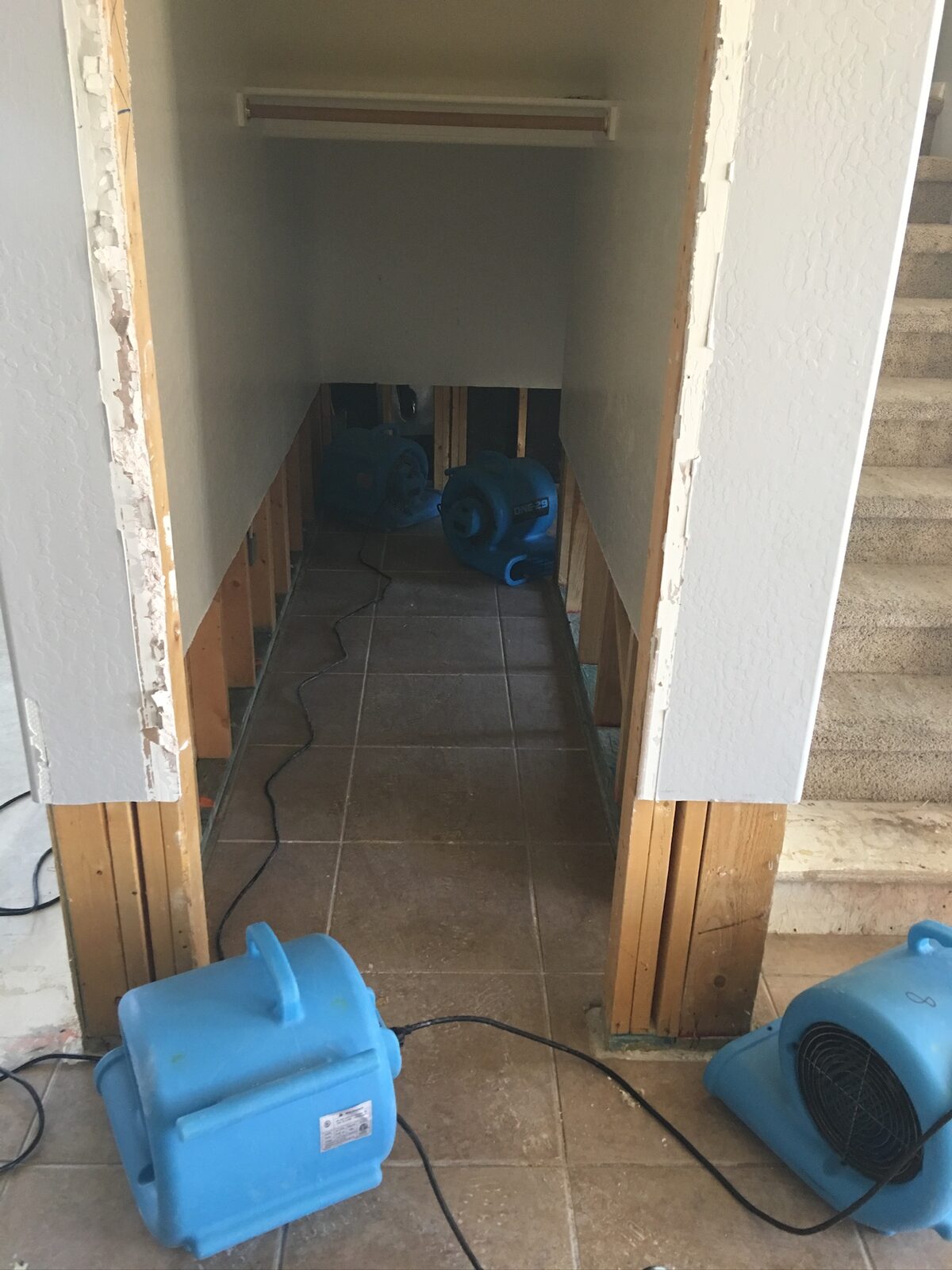
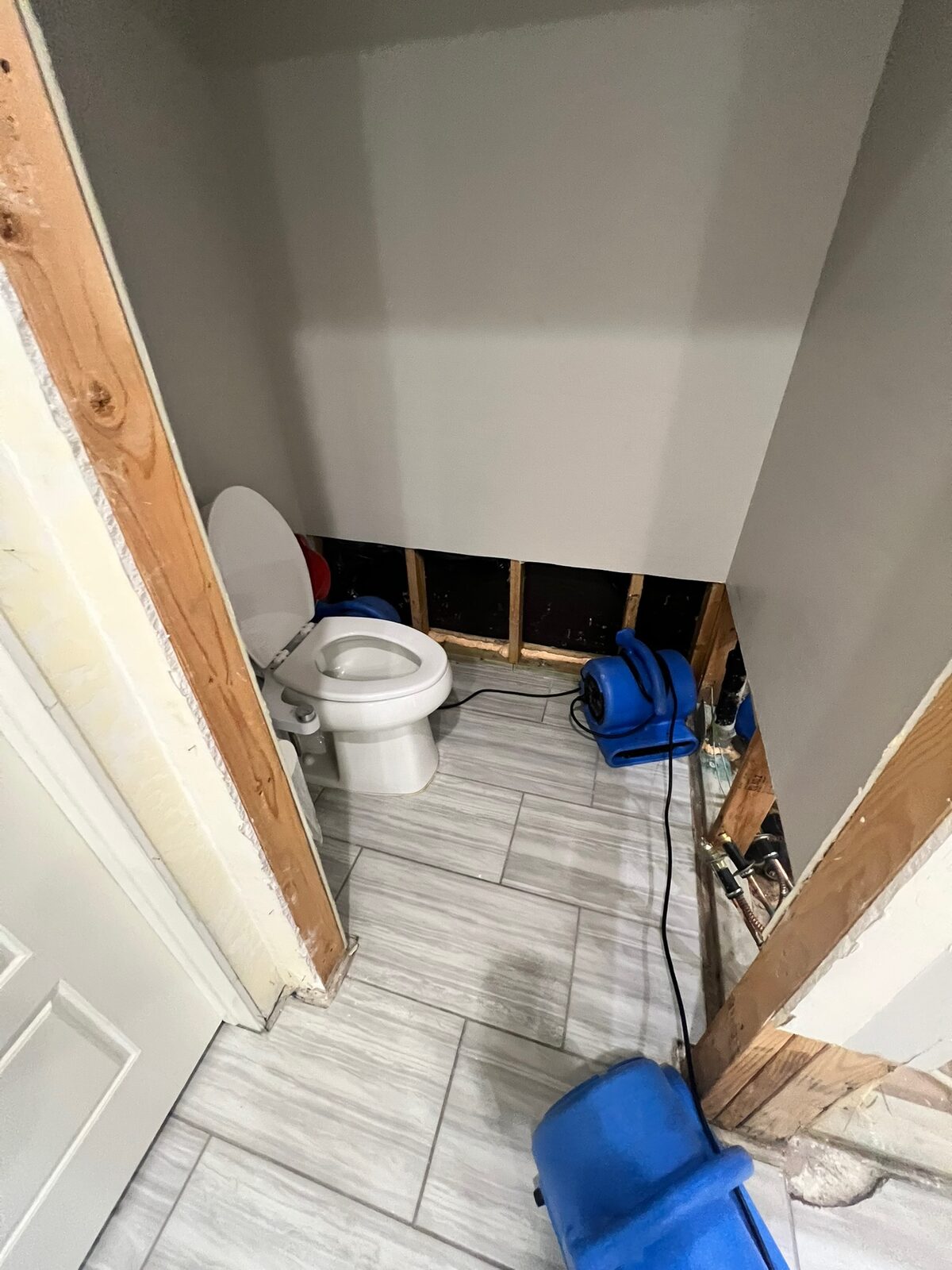
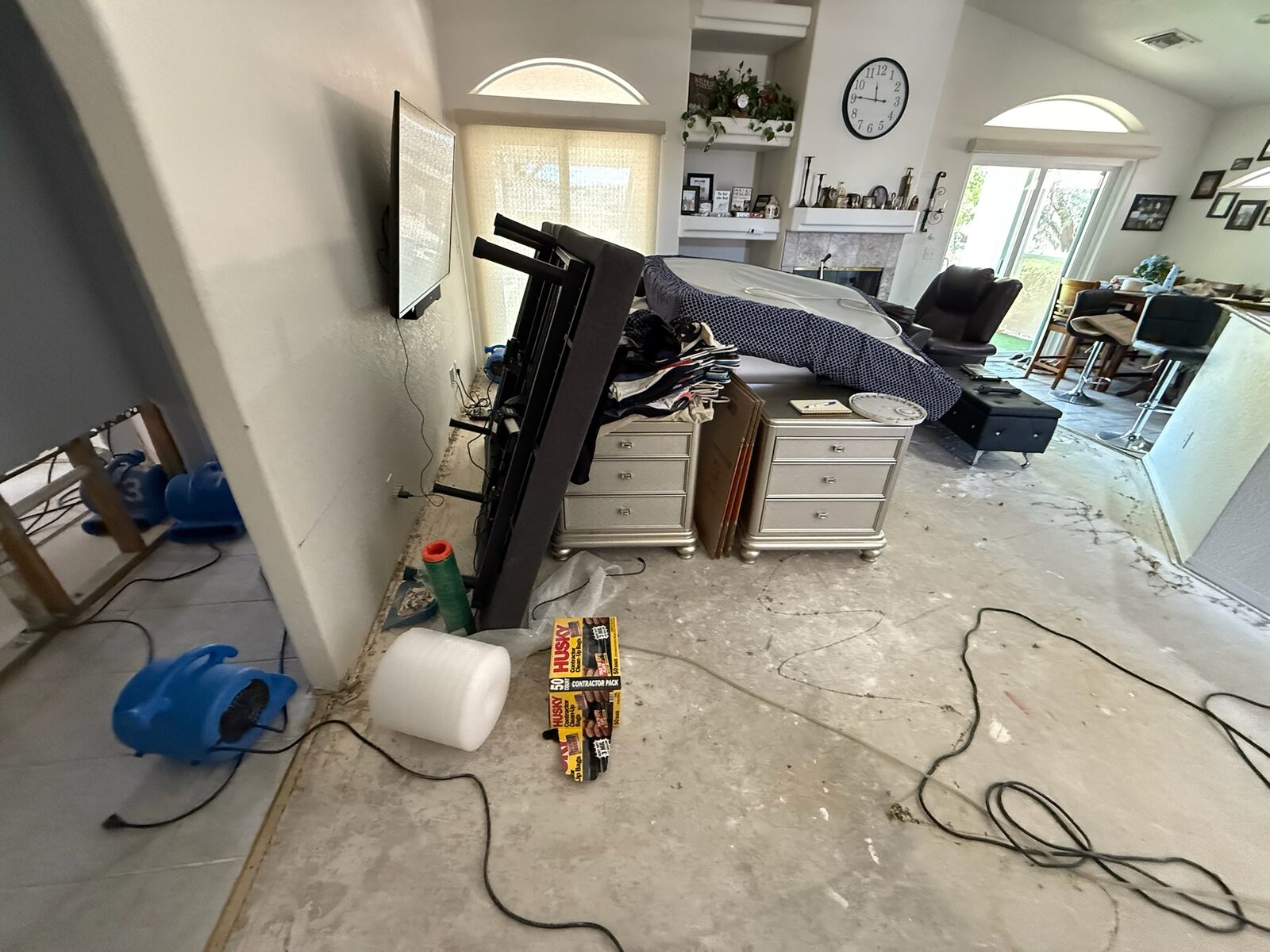
Residential reconstruction work by members of our team. See the full gallery →
More from Gold Water Fire
Abrasive Cleaning Methods for Soot on Framing and Masonry
A look at how abrasive cleaning methods remove soot from wood framing and masonry after a fire, and when each method fits the material.
AC Condensate Line Clogs & the Water Damage They Cause in Phoenix Homes
Why Phoenix AC condensate lines clog every summer, what the water damage looks like, and how to find the source before the ceiling stain spreads again.
Actual Cash Value vs Replacement Cost: Why Your Check Might Not Match the Repair Bill
Confused why your insurance check seems short after fire or water damage? Learn the difference between actual cash value and replacement cost coverage.
Not sure what you are dealing with?
If there is water in your home right now and you are trying to sort out the source, call Gold Water Fire at (480) 999-3339 or email Help@goldwaterfire.com. We work across the Phoenix metro: Phoenix, Mesa, Chandler, Gilbert, Scottsdale, Tempe, Glendale, Peoria, Avondale, Queen Creek, San Tan Valley, Apache Junction and the surrounding communities. AZ ROC #264344 · KB-2.
Call (480) 999-3339Water Damage Restoration · Fire Damage Restoration · Reconstruction & Rebuild · About Gold Water Fire · Contact