
Water Damage Restoration in Cave Creek, AZ
You have already done the hard part alone. You found the water, you shut off the valve or hit the breaker on the well pump, you pulled the rug back and stacked the towels, and you have spent the last few hours walking the same stretch of floor listening for a squish that will not go away. Maybe you ran fans all night. Maybe you are standing in a hallway at 4 a.m. wondering how far under the baseboard it went, and whether the answer is something you are equipped to find. That is an exhausting place to be, and the tiredness you are feeling right now is not a sign you handled it badly.
Water Damage Restoration in Cave Creek, AZ
Why Cave Creek homes lose water differently than valley-floor homes
Cave Creek sits at roughly 2,200 feet in the high Sonoran foothills, and that changes the failure pattern. A large share of the housing here went up during the growth waves of the 1990s and 2000s on custom and semi-custom lots, which means original polybutylene or early CPVC supply lines, first-generation water heaters that were replaced once and are now due again, and reverse osmosis or water softener systems that were installed to fight hard well water and have been quietly weeping at a fitting for months. Many properties are on private wells and septic rather than town water and sewer, so a pressure tank failure, a pump short-cycling, or a burst line between the well head and the house can dump water on the outside of the structure where nobody sees it until it wicks under a slab edge. Winter nights up here drop colder than Phoenix proper, and an unheated garage or an exterior hose bib on the north wall of a hillside home is genuinely at risk of freezing in a January cold snap.
Monsoon runoff and desert washes
The other Cave Creek pattern is not plumbing at all, it is water arriving from outside. Homes here are often built on grade near natural drainage: the Cave Creek wash itself, tributary channels off Black Mountain, and the countless small desert washes that look like harmless gravel swales eleven months of the year. During a July or August monsoon cell, an inch of rain in twenty minutes on hardpan caliche does not soak in, it runs. Water sheets across driveways, backs up against a garage threshold, finds the low door on a walkout basement or a casita, and enters through the door sweep or the slab cold joint. Flat and low-slope roofs on the contemporary and territorial-style homes common in the area add a second route, especially where a scupper or a canale is packed with palo verde litter. Storm water that has crossed a yard, a driveway, or a wash is not clean water, and drying it in place without addressing contamination is how homeowners end up with a musty return-air smell in September.
What proper drying looks like, in plain terms
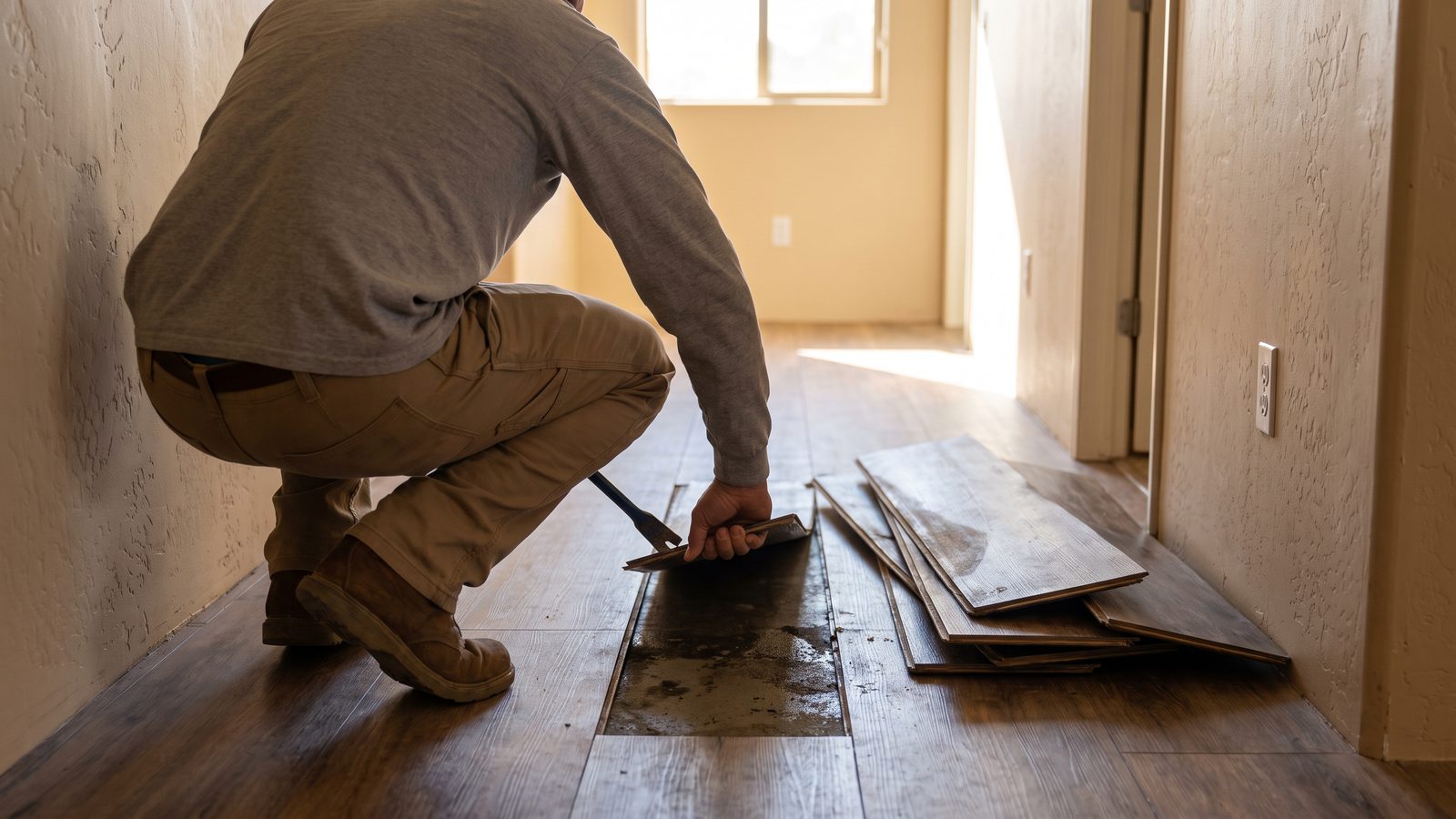
Water moves by capillary action, which means the wet edge is almost always further out than the visible stain. Real mitigation starts with mapping moisture using a pin or non-invasive meter against a dry-standard reading elsewhere in the same material, plus thermal imaging to spot temperature differences behind drywall. Then the water is extracted, not evaporated: pulling liquid out with equipment is dramatically faster and less destructive than trying to blow it dry. Trapped assemblies get opened or vented, which can mean removing base trim, drilling weep holes behind the baseboard line, floating a carpet to inject air beneath it, or detaching a small section of drywall rather than gutting a wall. Air movers create evaporation, dehumidifiers remove that moisture from the air so it does not simply redeposit in the next room, and readings get taken daily until the wet materials match the dry standard. Tile over slab is the classic Cave Creek trap: the tile looks fine, but the mortar bed and the slab beneath hold water for a long time, and cabinet toe kicks and the underside of an island are the last places to release it. Anything that has been wet in Arizona heat for more than a couple of days needs to be evaluated for microbial growth instead of just dried and closed up.
What it means to stop carrying this yourself
The reason to bring someone in is not that you failed at it. It is that the parts that matter most now, documenting the extent of the loss, proving the structure actually reached dry, and knowing when a wall has to open and when it does not, are the parts that need meters, equipment, and someone who has stood in this exact situation before. Gold Water Fire is licensed in Arizona under AZ ROC #264344 (KB-2), and the same company that dries your house can put it back: reconstruction and rebuild work is led by Construction Manager Brandon Gurr, so drywall, paint, trim, tile and cabinetry do not become a second search for a second contractor. Co-founders Jim Bennett and Jake Taylor built it that way on purpose. Brooke handles water and mitigation scheduling, Kristine keeps the paperwork and insurance documentation moving, and Johnny leads the reconstruction crew on site. You can read more about the water damage restoration process, meet the team on our about page, or just get in touch and describe what you are looking at.
Cave Creek and the north valley
We work the full Phoenix metro area, which includes Cave Creek, Carefree-adjacent neighborhoods, Desert Hills, north Scottsdale and Phoenix, and outlying properties past the edge of the pavement.
Well and septic properties
Homes on private well and septic have failure points a city-water home does not: pressure tanks, pump houses, buried supply runs, and softener or RO equipment. Tell us if you are on well water when you call.
One company, start to finish
Mitigation and rebuild under one license means the person who documented what came out is connected to the person who puts it back.
Questions people ask us
My floor still feels damp after running fans for two days. Is that normal?
It is common, and it usually means evaporation is happening but the moisture has nowhere to go. Fans move air, they do not remove water from the air. Without dehumidification the moisture redeposits into other materials, and without extraction the liquid still sitting in a mortar bed, subfloor or insulation cavity can take far longer than the surface suggests. A meter reading against a dry standard is the only way to know.
Water came in from the wash during a monsoon storm. Is that treated differently than a broken pipe?
Yes. Water from a supply line is clean at the point of failure. Storm and runoff water has crossed soil, pavement, landscaping and possibly a septic field, so it is treated as contaminated. Porous materials like carpet pad, particleboard and wet insulation are typically removed rather than dried in place, and affected surfaces need cleaning and antimicrobial treatment, not just air movement.
Will you have to tear out my walls?
Not always, and the goal is to remove as little as possible. Often it is enough to pull base trim, drill discreet weep holes behind the baseboard line, and dry the cavity from below. Full removal becomes the right call when insulation is saturated, when the water was contaminated, or when a material has been wet long enough that growth is a real concern.
Can the same company handle the repairs after drying?
Yes. Gold Water Fire is licensed in Arizona under AZ ROC #264344 (KB-2) and handles reconstruction and rebuild in house, led by Construction Manager Brandon Gurr. Drywall, texture, paint, trim, tile and cabinetry are part of the same job rather than a separate search on your part.
The standard our team works to
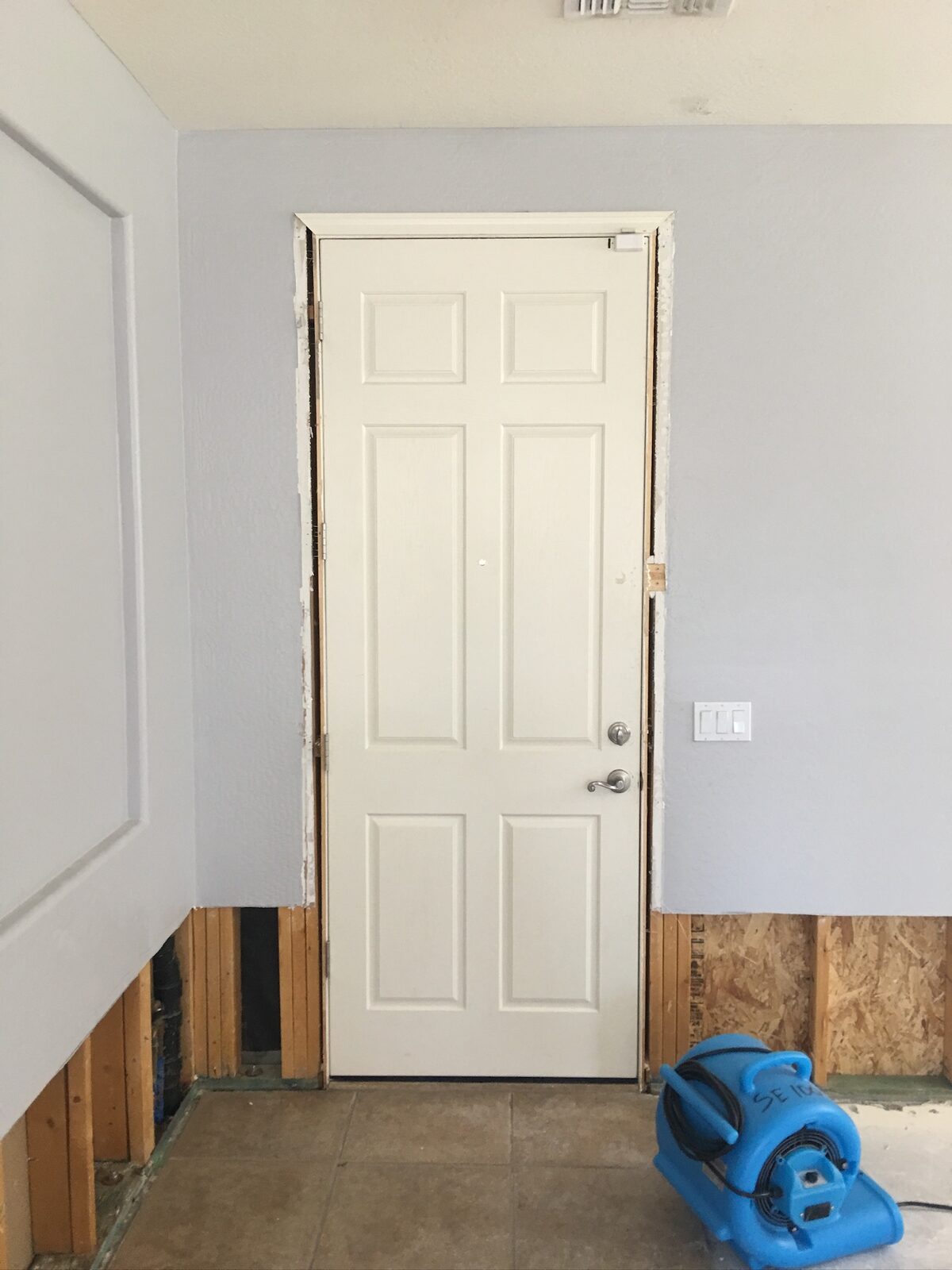
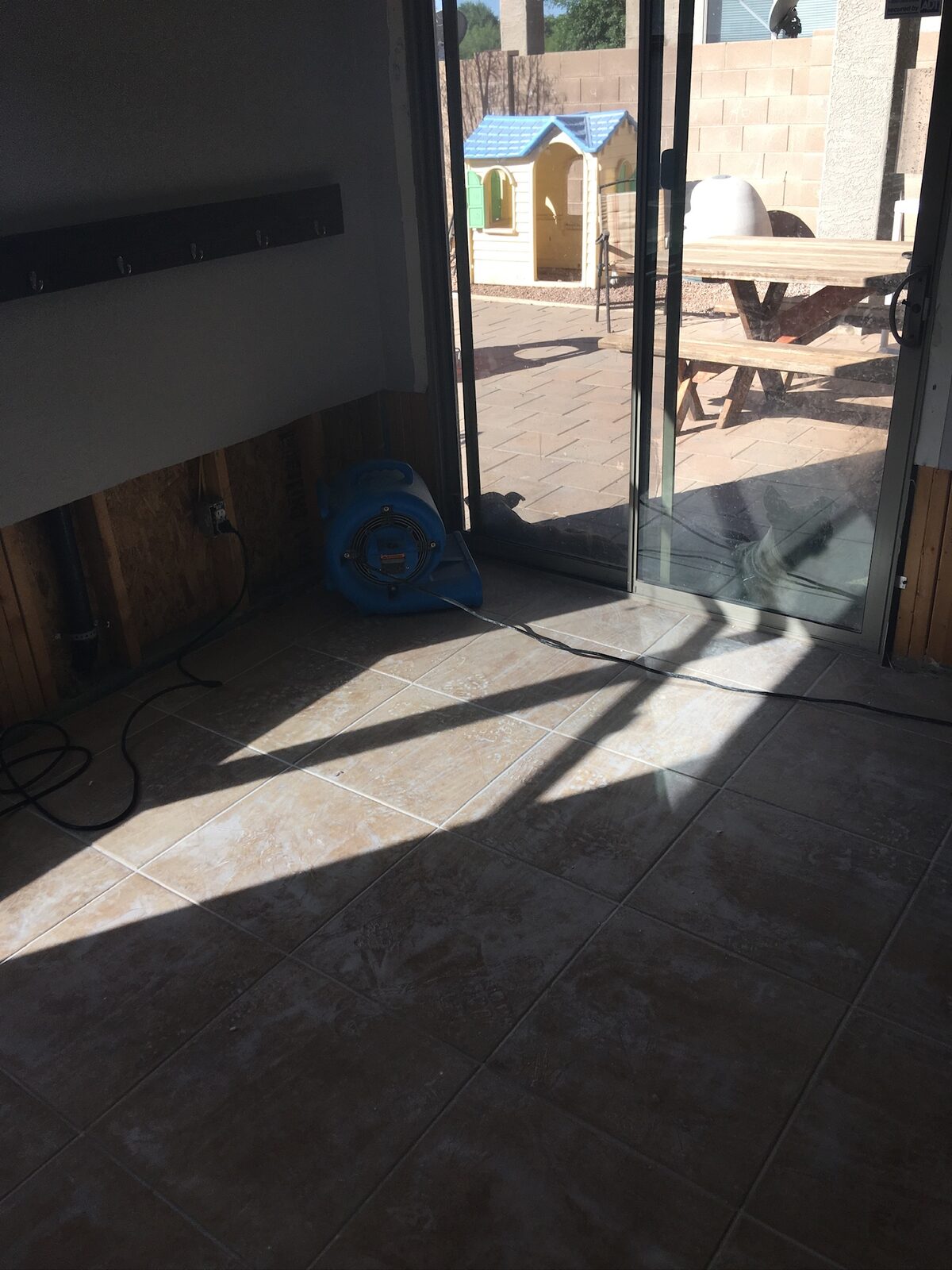
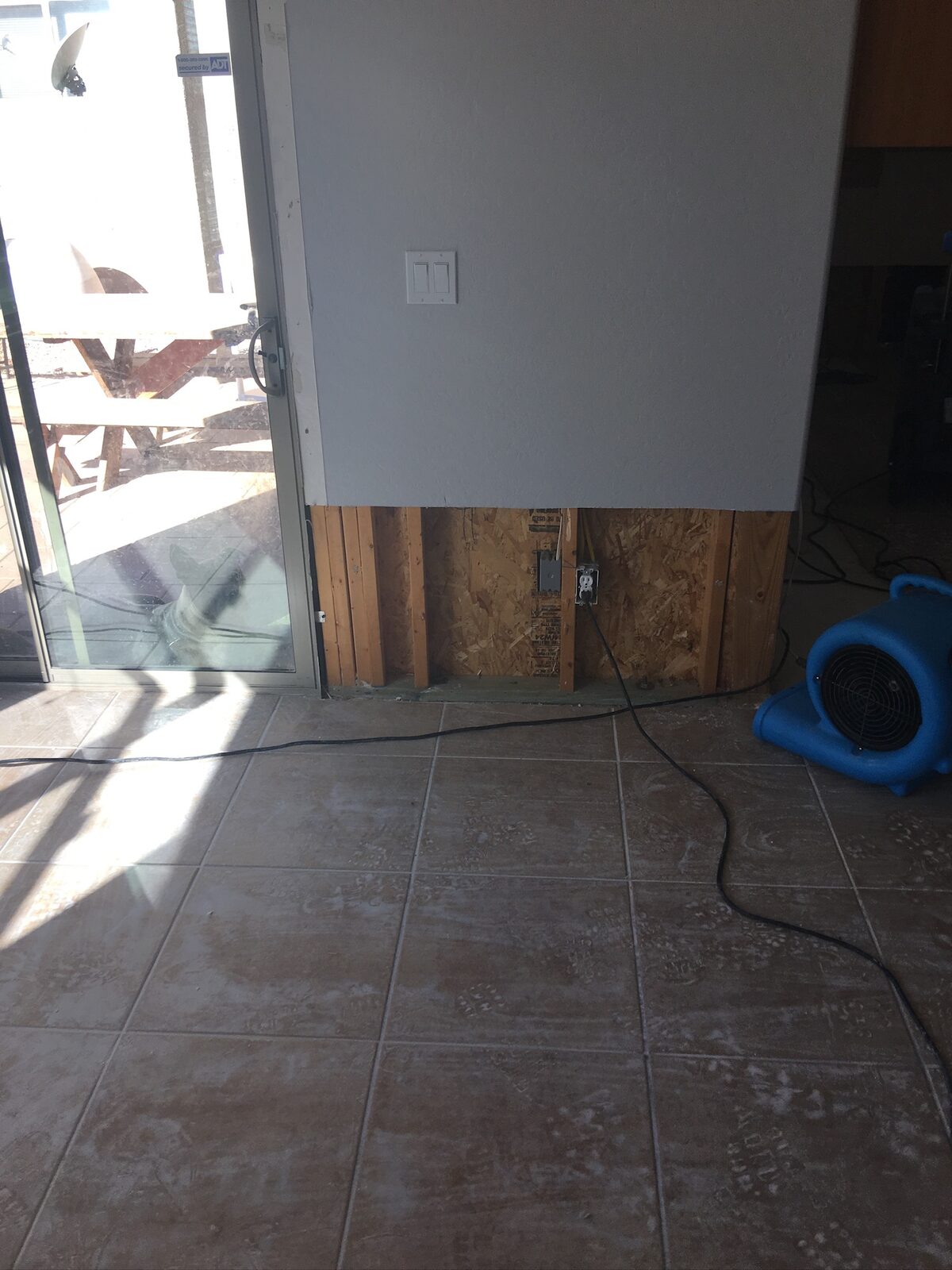
Residential reconstruction work by members of our team. See the full gallery →
More from Gold Water Fire
Fire Damage Restoration in Apache Junction, AZ
Fire and smoke damage restoration for Apache Junction homes, from board-up and soot cleanup through rebuild. Gold Water Fire, AZ ROC #264344. Call (480) 999-3339.
Reconstruction & Rebuild in Apache Junction, AZ
Rebuilding a damaged Apache Junction home after water or fire: framing, drywall, stucco, cabinets and flooring put back by Gold Water Fire. Call (480) 999-3339.
Water Damage Restoration in Apache Junction, AZ
Water damage restoration for Apache Junction homes, from slab leaks and monsoon flooding to failed water heaters. Call Gold Water Fire at (480) 999-3339.
Tell us what you are looking at
Call (480) 999-3339 or email Help@goldwaterfire.com and describe the room, the water, and how long it has been there. If you are on a well, say so. We will tell you what we would check first, whether or not you decide to hand it over.
Call (480) 999-3339Water Damage Restoration · Reconstruction & Rebuild · Fire Damage Restoration · About Gold Water Fire · Contact