
Water Damage Restoration in Peoria, AZ
You have already done the hard part on your own. You found the shutoff, you pulled the rug up off the tile, you moved the boxes off the garage floor, you ran towels through the dryer twice. Somewhere around the second or third hour it stopped feeling like a chore and started feeling like a question you cannot answer: is the floor actually dry, or does it just feel dry on top? That is a fair thing to be unsure about. Water travels sideways under baseboards and up through drywall long before anything looks wrong, and no amount of effort with a shop vac tells you what is happening inside a wall cavity.
Water Damage Restoration in Peoria, AZ
Why Peoria homes take on water the way they do
Peoria is not one housing stock, it is three. The older core around Grand Avenue and Old Town has homes built decades before the north end existed, and those tend to carry the oldest plumbing: galvanized supply lines that corrode from the inside, cast iron drains, and slab construction where a pinhole leak shows up as a warm spot on the floor or an unexplained jump in the water bill rather than a visible puddle. The mid-century and 1970s-80s tracts south of Bell have their own signature problem, original angle stops and washing machine supply hoses that were never replaced, plus water heaters sitting in garages or interior closets with no pan and no drain line. Then there is everything north of Happy Valley and out toward Vistancia and Lake Pleasant, built from the late 1990s onward, where the failures are newer-house failures: fittings on PEX or CPVC manifolds, refrigerator ice maker lines, second-floor laundry rooms, and upstairs bathrooms that dump into the ceiling below when a supply line lets go. The elevation change across the city matters too. Homes up in the north Peoria foothills sit on desert terrain that sheds water fast during monsoon cells, so the risk is less about slow rise and more about sheet flow finding a low threshold, a garage slab, or a courtyard drain that filled with gravel and decomposed granite. Closer to the New River and Skunk Creek washes, and in the older flatter neighborhoods where lots were graded generations ago, drainage was never designed for a two-inch hour.
Monsoon, winter storms, and the pipe problems in between
From roughly July into September, the monsoon delivers a lot of rain in a short window along with wind that lifts roof tiles and drives water under them. In Peoria that often shows up a day or two later as a brown ring on a ceiling or a soft spot in a second-floor closet, because the water sat in the roof deck first. Tile roofs are especially deceptive: the tile can look untouched while the underlayment beneath it has failed, and the leak reappears with every storm. Winter is the quieter season and it is when plumbing failures dominate. Overnight lows in north Peoria run colder than they do closer to central Phoenix, and exposed lines in unheated garages, along exterior walls, at hose bibs, or feeding a backflow preventer on an irrigation system can split. The break often does not announce itself until the line thaws and pressurizes. Spring and fall bring the irrigation and pool side of things, drip lines run for a full cycle after a valve sticks, or a pool autofill sticks open and pushes water toward the house instead of away from it. And year round, hard water is quietly working on every fixture in the house. Mineral scale shortens the life of water heaters, softener bypass valves, and toilet fill valves, which is why a Peoria water heater that gets no maintenance can fail earlier than the label suggests.
What proper drying involves, and what fans alone will not do
Restoration drying is not the same as making a surface feel dry. The process starts with finding the actual boundary of the wet area, using moisture meters on the surface and probing behind baseboards and into wall cavities, and often thermal imaging to see where evaporative cooling reveals moisture the eye cannot. Every wet material is compared against a dry standard elsewhere in the same house, so there is a number to work toward rather than a guess. From there, the category of the water drives everything. Clean supply water is one situation. Water from a dishwasher, a washing machine, or a long-standing leak is a different one, and sewage or a backed up main line is a third that requires removal of porous materials rather than drying them. Containment gets set so you are drying one room instead of the whole house. Air movers are placed to push air across wet surfaces at an angle, not simply pointed at a puddle, and dehumidifiers pull the released moisture out of the air so it does not just relocate to a cooler wall. Baseboard often comes off and small inspection holes go into the drywall so air can reach the cavity, and wet insulation usually comes out because it holds water against the framing. Readings get taken daily until the materials match the dry standard. The reason this matters in Phoenix specifically: outdoor air is dry most of the year, which tempts people to open windows and call it a plan. During monsoon humidity that backfires outright, and even in dry months it does nothing for water sealed inside a wall cavity or under a laminate floor. Materials left damp behind a wall are where mold gets its start, typically within a couple of days. Read more about how we approach the whole sequence on our water damage restoration page.
Before we arrive
Shut the water off at the source if you can find it, or at the main by the street. Cut power to the affected rooms at the breaker if water is anywhere near outlets or the panel. Take photos of everything wet before you move it, your insurer will want them.
What to protect
Lift furniture legs onto foil or blocks so stain does not bleed into carpet. Get books, paper, and electronics up off the floor. Leave heavy soaked rugs and pad where they are, dragging them spreads contamination.
What not to do
Do not run a household box fan across sewage or gray water, it aerosolizes what is in it. Do not use a household vacuum on standing water. Do not tear out drywall before it is documented.
When drywall comes out
Not every wet wall needs demolition. Drywall that has swelled, delaminated, or been soaked by contaminated water is removed. Drywall wet by clean water and caught early can often be dried in place with cavity airflow.
Getting the house back to a house
Drying stops the damage. It does not put the room back. In a lot of Peoria homes, the affected area is tile with a mortar bed, engineered wood in an open great room, or carpet running continuously from a hallway into three bedrooms, which means the repair rarely stops at the wet square footage. Baseboard has to be replaced and repainted, cabinet toe kicks and sometimes cabinet boxes need rebuilding, and texture has to be matched so a patched wall does not read as a patch. We handle that side of it as well, under AZ ROC license #264344, KB-2. Brandon Gurr, our Construction Manager, leads the rebuild work, and Johnny runs the reconstruction crew day to day, so the same company that dried the house is the one putting it back together. That matters mostly because it removes a handoff, you are not explaining the whole story again to a second contractor with a different schedule. Details are on the reconstruction and rebuild page, and you can read about the people doing it on our about page. Gold Water Fire works the full Phoenix metro area, from northwest Peoria across to southeast Avondale, southwest San Tan Valley, northwest Apache Junction, and outlying areas beyond that. Peoria sits at the northwest edge of that, which we say plainly because it is one of the areas we cover routinely rather than an exception.
Questions people ask us
How fast does mold become a problem after water damage?
As a general rule in the restoration industry, mold can begin developing on damp organic materials like drywall paper, wood framing, and carpet pad within about 24 to 48 hours of them staying wet. The Phoenix climate does not exempt a home from that, because the moisture that matters is the moisture trapped inside the wall or under the flooring where the dry outdoor air never reaches. That is why drying is measured with meters instead of judged by touch.
My ceiling stained after a monsoon storm but it is dry now. Do I still need someone to look?
Usually yes. A stain means water passed through, and on a tile roof the failure is normally in the underlayment rather than the tile, so it will repeat with the next storm. The other issue is that the insulation and framing above the ceiling can hold moisture long after the drywall surface feels dry to the touch. A moisture reading in the attic answers the question quickly, and it is a much smaller conversation than a collapsed section of ceiling later.
Will my homeowners insurance cover this?
That depends on your policy and the cause. In broad terms, sudden and accidental events like a burst supply line or a failed water heater are treated differently from long-term seepage or a maintenance issue that went unaddressed, and flooding from outside the home is usually a separate policy entirely. Photograph everything before you move it, keep any failed part, and report it promptly. We document moisture readings and the scope of work in a form insurers are used to receiving.
Do you cover all of Peoria, including the north end?
Yes. We serve the full Phoenix metro area, which includes Peoria from Old Town and the older neighborhoods near Grand Avenue out through the north Peoria communities toward Lake Pleasant, along with Glendale, Surprise, El Mirage, and the surrounding cities. Call (480) 999-3339 and tell us the cross streets.
The standard our team works to
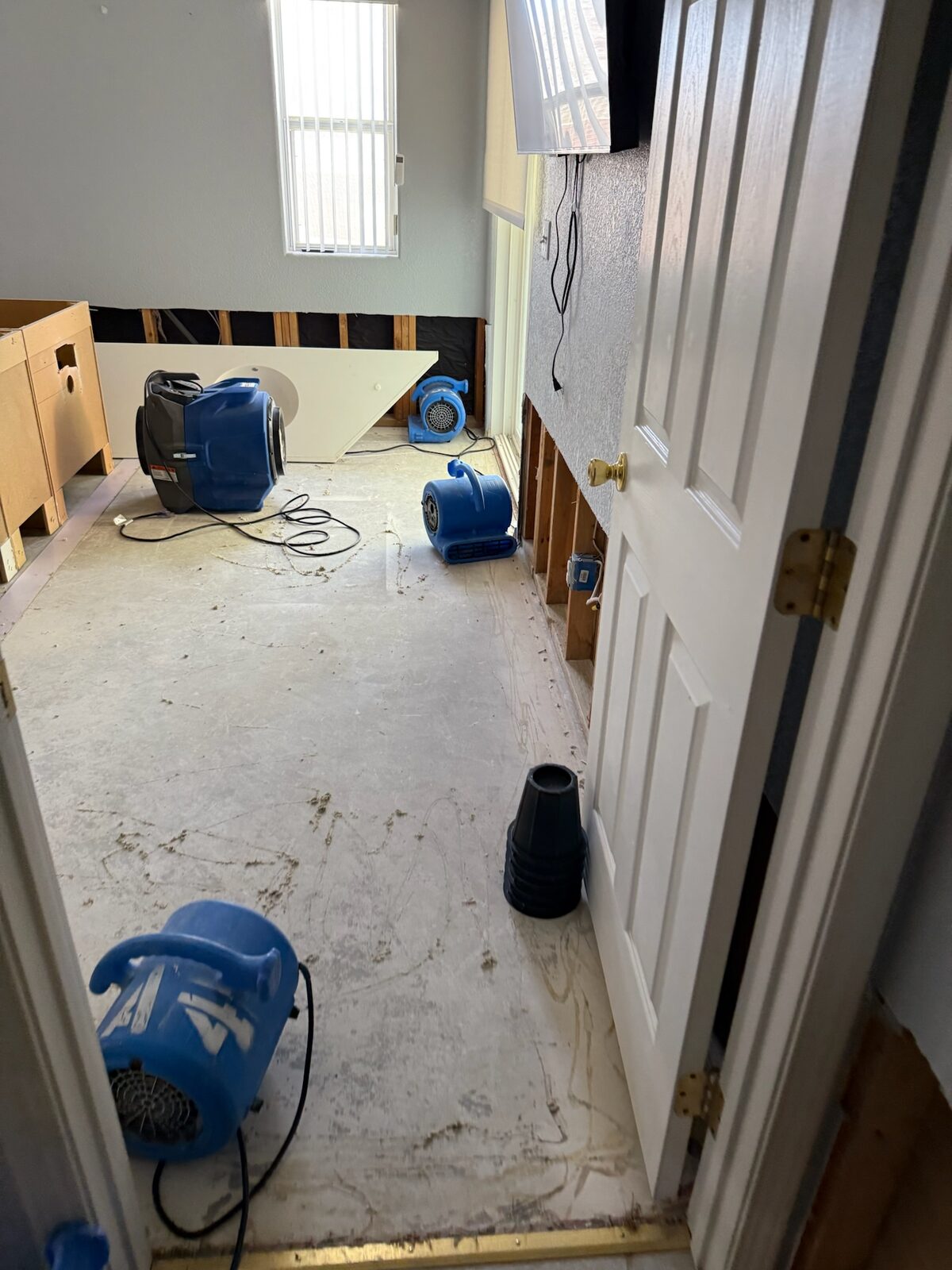
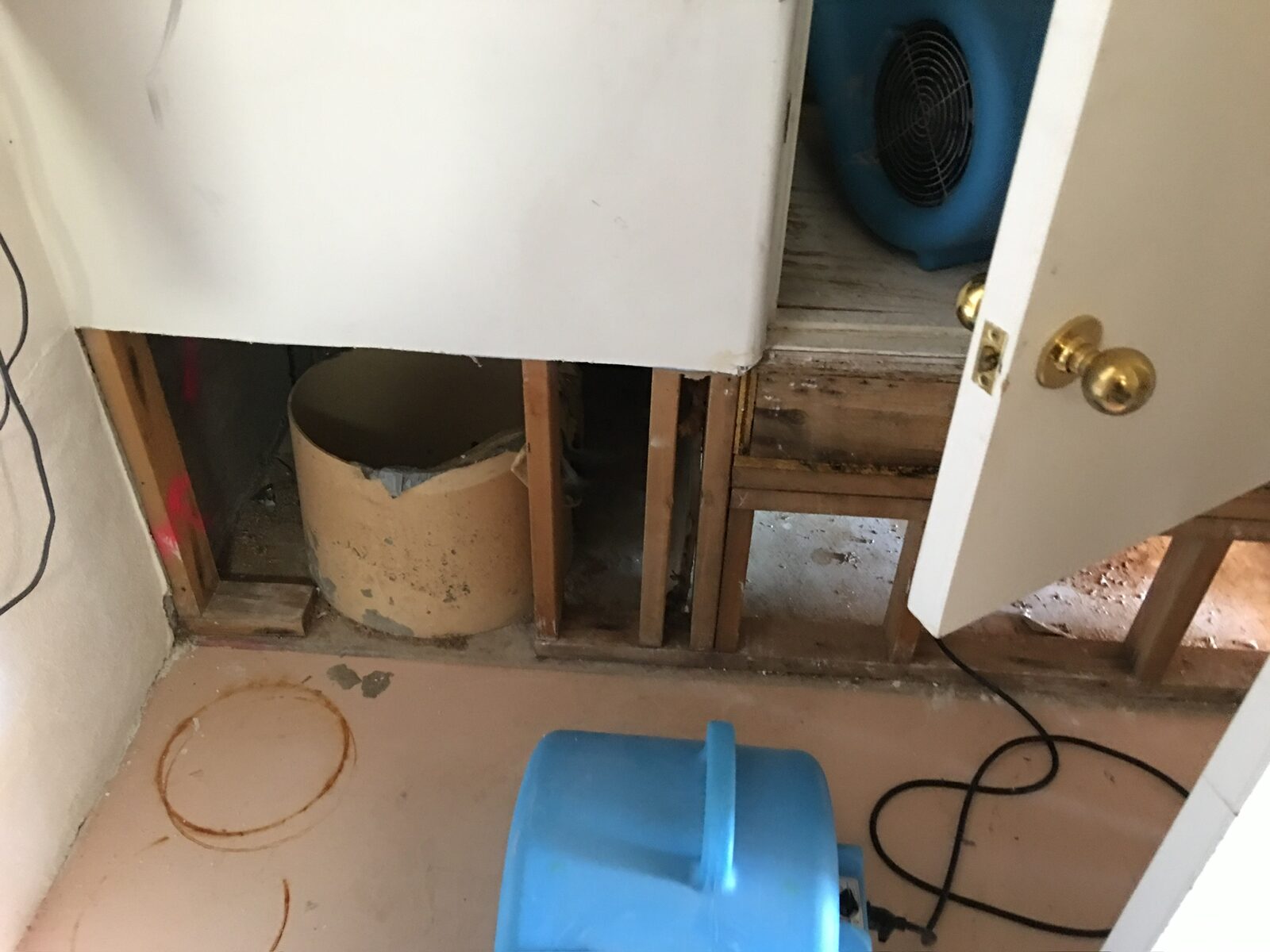
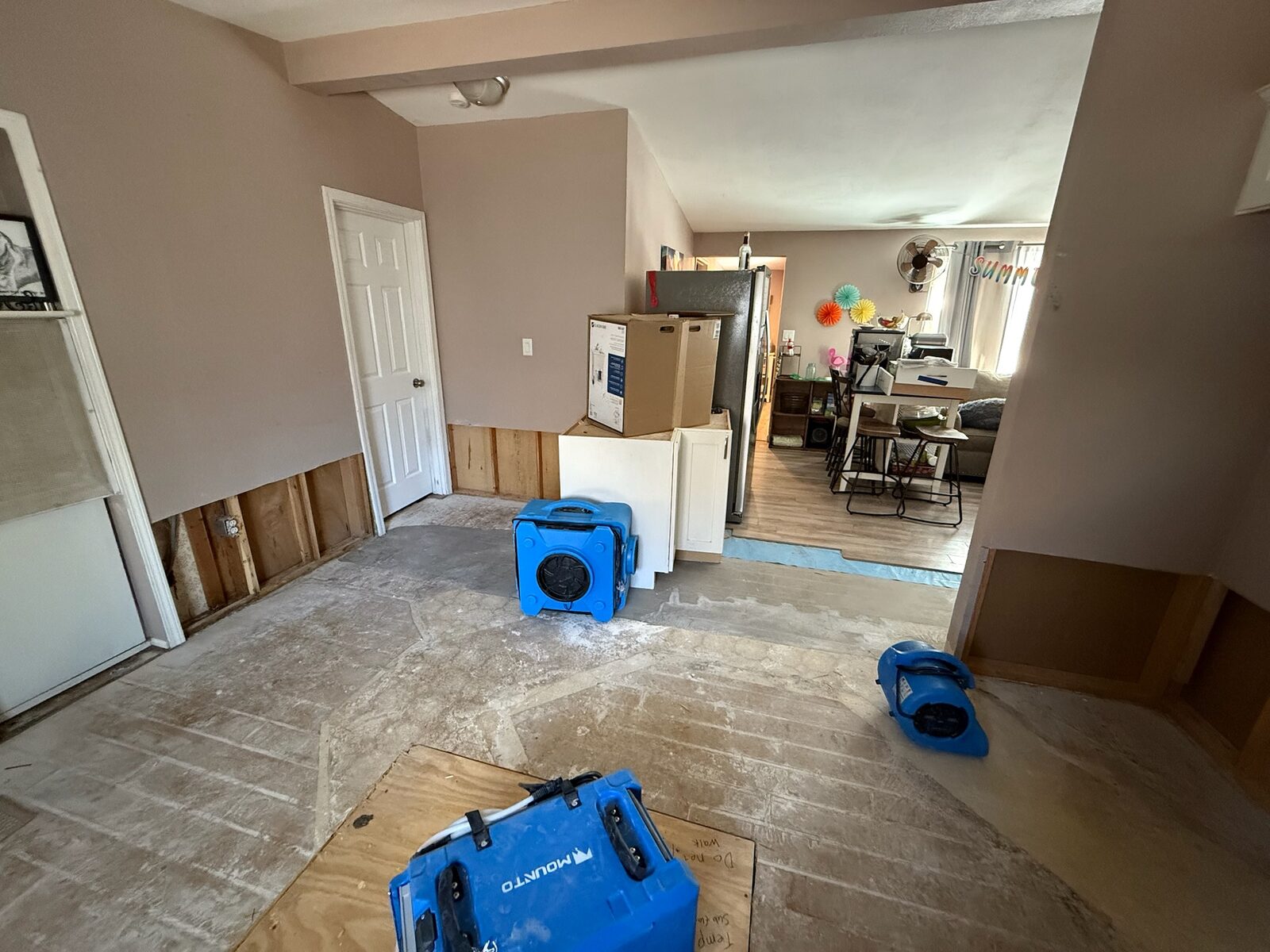
Residential reconstruction work by members of our team. See the full gallery →
More from Gold Water Fire
Fire Damage Restoration in Apache Junction, AZ
Fire and smoke damage restoration for Apache Junction homes, from board-up and soot cleanup through rebuild. Gold Water Fire, AZ ROC #264344. Call (480) 999-3339.
Reconstruction & Rebuild in Apache Junction, AZ
Rebuilding a damaged Apache Junction home after water or fire: framing, drywall, stucco, cabinets and flooring put back by Gold Water Fire. Call (480) 999-3339.
Water Damage Restoration in Apache Junction, AZ
Water damage restoration for Apache Junction homes, from slab leaks and monsoon flooding to failed water heaters. Call Gold Water Fire at (480) 999-3339.
Let someone else carry the next part
You have already found the leak, moved what you could, and kept the house together through a bad night. The part that comes next needs meters, dehumidifiers, and someone who can tell you what is happening inside the wall, and there is no reason that has to be you. Call Gold Water Fire at (480) 999-3339 or email Help@goldwaterfire.com, or use our contact page. Tell us what happened and where in Peoria you are, and we will take it from there.
Call (480) 999-3339Water Damage Restoration · Reconstruction & Rebuild · Fire Damage Restoration · About Gold Water Fire · Contact Us