
Water Damage Restoration in Goodyear, AZ
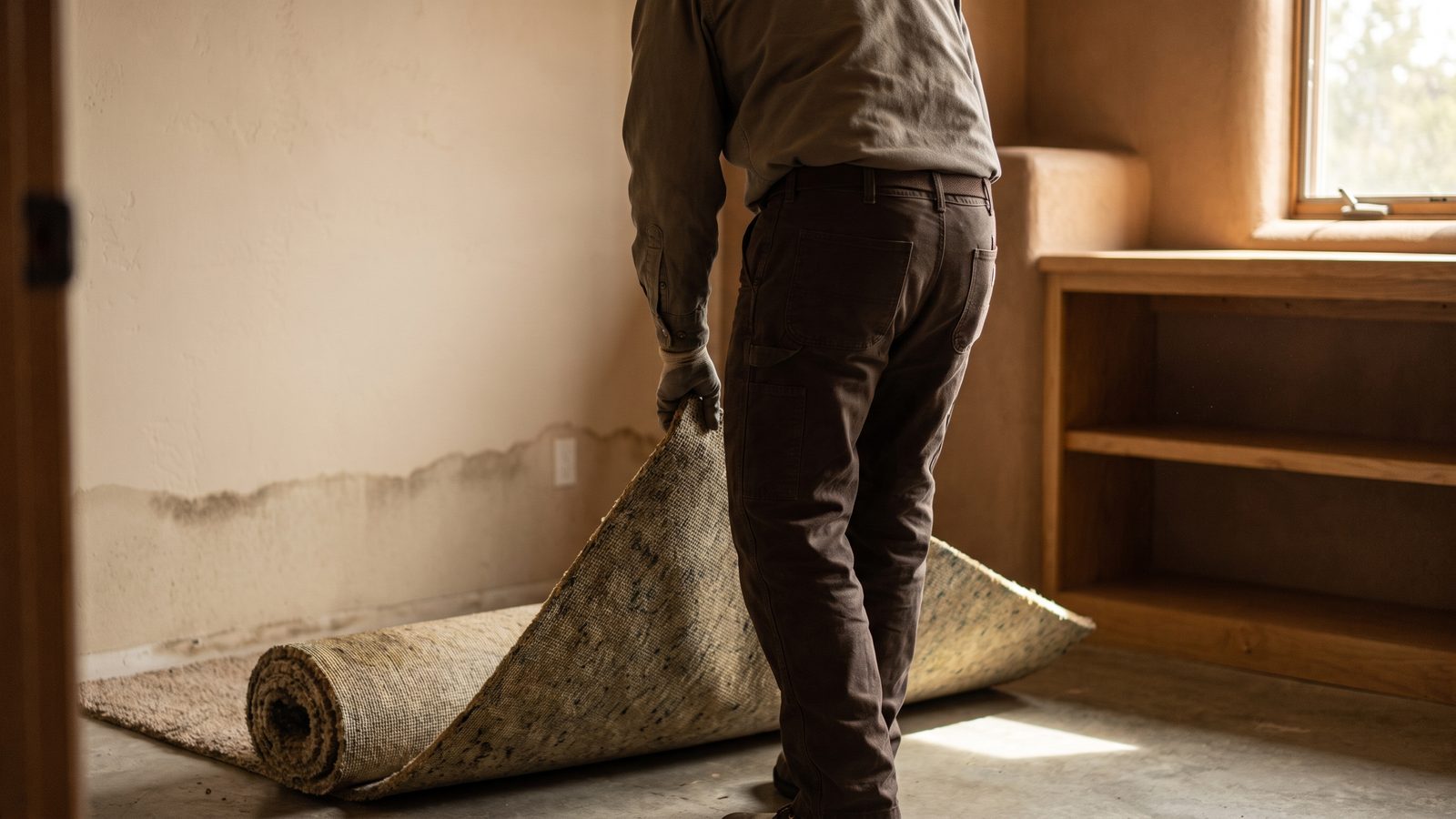
You have been up since the water started, and you have already done more than most people would. You shut off the valve at the street, you pulled the rug out into the driveway, you moved the boxes off the garage floor, you ran the shop fan all night and checked the baseboards again this morning to see if the dark line had moved. That is real work, and it mattered. What is hard is that the floor still feels cool in one spot, the room still smells faintly like a wet towel, and you cannot tell from the outside whether the wall behind the drywall is dry or just quiet. That uncertainty, after all the effort you have already put in, is its own kind of exhausting.
Water Damage Restoration in Goodyear, AZ
Why water behaves the way it does in Goodyear homes
Goodyear grew fast, and most of the housing stock reflects it. West of the Estrella Parkway and out through Estrella Mountain Ranch, Palm Valley, Canyon Trails and PebbleCreek, you are largely looking at slab-on-grade construction from the late 1990s through the 2000s and 2010s: post-tension slabs, wood-frame walls with paper-faced drywall, engineered wood or laminate flooring in the main living areas, and carpet in the bedrooms over standard pad. There is very little crawlspace and almost no basement, which changes everything about how a leak spreads. Water does not drain down and away, it runs flat. It follows the slope of the slab and the path of least resistance under the flooring, and it wicks up into the bottom of the drywall by capillary action. That is why a supply line failure at a second-floor laundry in a two-story Palm Valley home can show up as a ceiling stain in the kitchen and a damp baseboard in a downstairs bedroom that seems unrelated to the leak. It is also why the visible wet patch on the floor is almost never the true edge of the water. Older Goodyear housing sits in the historic townsite near Western Avenue and in the neighborhoods around Litchfield Road, where you find smaller mid-century homes with original or partially replaced galvanized and copper plumbing. Copper pinhole leaks are common in valley homes at the twenty to thirty year mark, and they tend to weep slowly inside a wall for weeks before anyone notices a warm spot on the floor or a jump in the water bill.
Monsoon, freeze snaps and the dry-air problem
From roughly June into September, monsoon storms move across the West Valley and drop a lot of rain in a short window on ground that does not absorb it. Goodyear sits in flat agricultural terrain that was leveled for farming long before it was subdivided, so runoff pools rather than sheds. The common calls in that season are not dramatic floods, they are roof penetrations around a satellite mount or a solar attachment, wind-driven rain forced sideways under a tile ridge or into a stucco crack, water backing up at a scupper or a flat patio-roof drain, and water finding its way in through a garage threshold or a slider track when the wind is behind it. Winter brings a different failure. A hard cold snap in December or January will freeze an uninsulated hose bib, an exposed backflow preventer on an irrigation line, or a pool equipment line, and the split does not always show until things thaw and pressure returns. Landscape irrigation is a year-round source too, because a broken lateral running against a foundation for days can push moisture under a slab edge with nothing above ground to show for it. The dry Arizona air causes its own trap. Surfaces here evaporate fast, so a floor can feel dry to the hand in a day or two while the wall cavity, the subfloor seam and the underside of the flooring stay wet. Homeowners reasonably conclude the problem solved itself. In a closed cavity with limited airflow, microbial growth can begin within a couple of days of materials staying wet, which is why drying is measured with meters rather than judged by touch.
What actual drying involves, and why fans alone often are not enough
Proper structural drying is a measured process, not a matter of pointing air at a wet spot. It generally runs like this. First, the source is stopped and the water is categorized, because clean supply water, gray water from a dishwasher or washing machine, and sewage backup each call for different handling and different decisions about what can be saved. Next comes moisture mapping: meters and thermal imaging are used to trace how far the water actually traveled, marking the wet perimeter on walls and floors so drying is aimed at the real boundary instead of the visible stain. Then standing water is extracted, including weighted extraction through carpet and pad where that applies. Materials that hold water and cannot be dried in place, like carpet pad, saturated insulation and swollen MDF baseboard or cabinet toe kicks, are removed. Where water has run behind baseboard into a wall, small controlled openings or drilled holes let air move into the cavity, because a sealed wall will not dry from the outside. Air movers are placed to create directed airflow across wet surfaces, and dehumidifiers pull the released moisture out of the air rather than just circulating it around the room. Readings are taken daily and compared against an unaffected part of the house to establish a dry standard for that specific home. Drying stops when the numbers say the materials have returned to that standard, not when the room seems fine. Documentation of those readings is also what an insurance adjuster looks for when reviewing a claim. Once a structure is dry, the repair side begins: drywall, texture matched to the surrounding wall, paint, trim, flooring and cabinetry. Learn more about how we approach water damage restoration and the reconstruction and rebuild work that puts a room back together afterward.
Handing it over to someone in Goodyear
Gold Water Fire is a licensed Arizona contractor, AZ ROC #264344 KB-2, working out of Chandler and serving the full Phoenix metro area, which includes Goodyear and the rest of the West Valley alongside Avondale, Litchfield Park, Buckeye, Tolleson and Glendale. We were founded by Jim Bennett and Jake Taylor, and Brandon Gurr runs our construction side, so the drying and the rebuild are handled by one company rather than handed off to a stranger halfway through. When you call, you will talk to real people: Kristine in the office, Brooke on water and mitigation scheduling, and Johnny leading the reconstruction crew. That single-company structure matters more than it sounds. The most common frustration homeowners describe is a mitigation crew that dries the house, pulls its equipment and disappears, leaving open walls and no clear answer about who puts the kitchen back. Because we do both, the person who mapped the moisture and cut the drywall is on the same team as the person who hangs the new board and matches your texture. You do not have to keep guessing whether the wall behind the baseboard is dry. That is a question with an actual answer, and it is one someone can come read for you. You can reach us at (480) 999-3339 or Help@goldwaterfire.com, see more about our team, or use the contact page. If there was fire or smoke involved as well, we handle fire damage restoration too.
Questions people ask us
The floor looks dry now. Do I still need someone to look at it?
It is worth checking. Arizona's dry air evaporates surface moisture quickly, which makes a floor feel dry while the subfloor seam, the flooring underlayment and the bottom of the wall cavity stay wet. Moisture meters and thermal imaging read what your hand cannot. If the readings match an unaffected part of the house, you have a clear answer and can stop worrying about it.
Do you serve all of Goodyear, including Estrella and PebbleCreek?
Yes. We serve the full Phoenix metro area, which covers all of Goodyear from the historic townsite near Western Avenue out through Palm Valley, Canyon Trails, PebbleCreek and Estrella Mountain Ranch, along with neighboring Avondale, Litchfield Park, Buckeye and Tolleson.
Why do walls have to be opened up instead of just dried with fans?
A closed wall cavity has almost no airflow, so moisture trapped behind drywall and insulation can sit for a long time even with fans running in the room. Controlled openings at the base of the wall, or small drilled holes behind where the baseboard sits, let air move through the cavity so a dehumidifier can actually pull that moisture out. Openings are kept as small as the drying allows.
Can you also handle the repairs after the drying is done?
Yes. Gold Water Fire handles both the mitigation and the reconstruction, including drywall, texture matching, paint, trim, flooring and cabinetry. Brandon Gurr, our Construction Manager, leads the rebuild side, so you are not left finding a separate contractor once the equipment comes out.
The standard our team works to
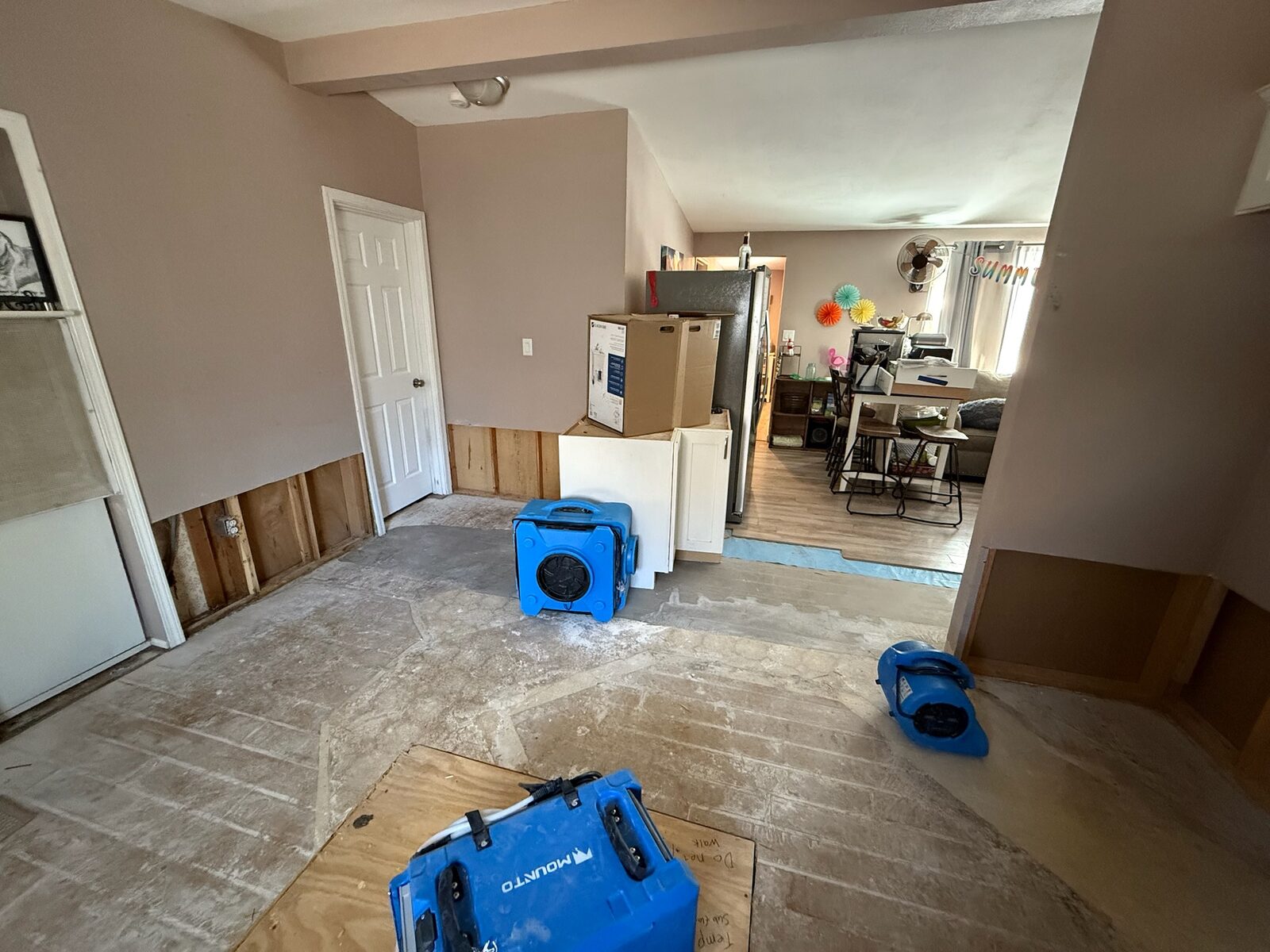
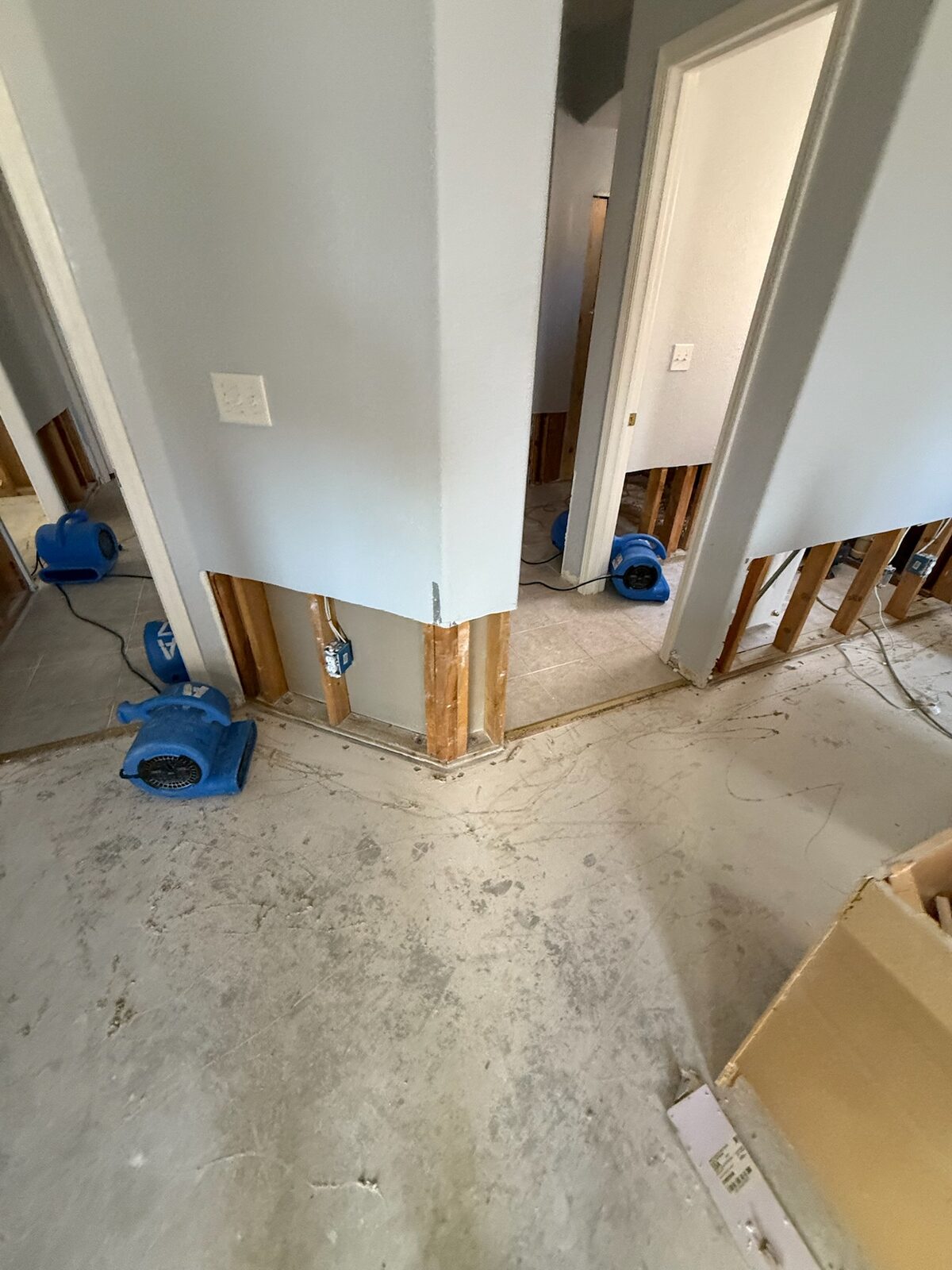
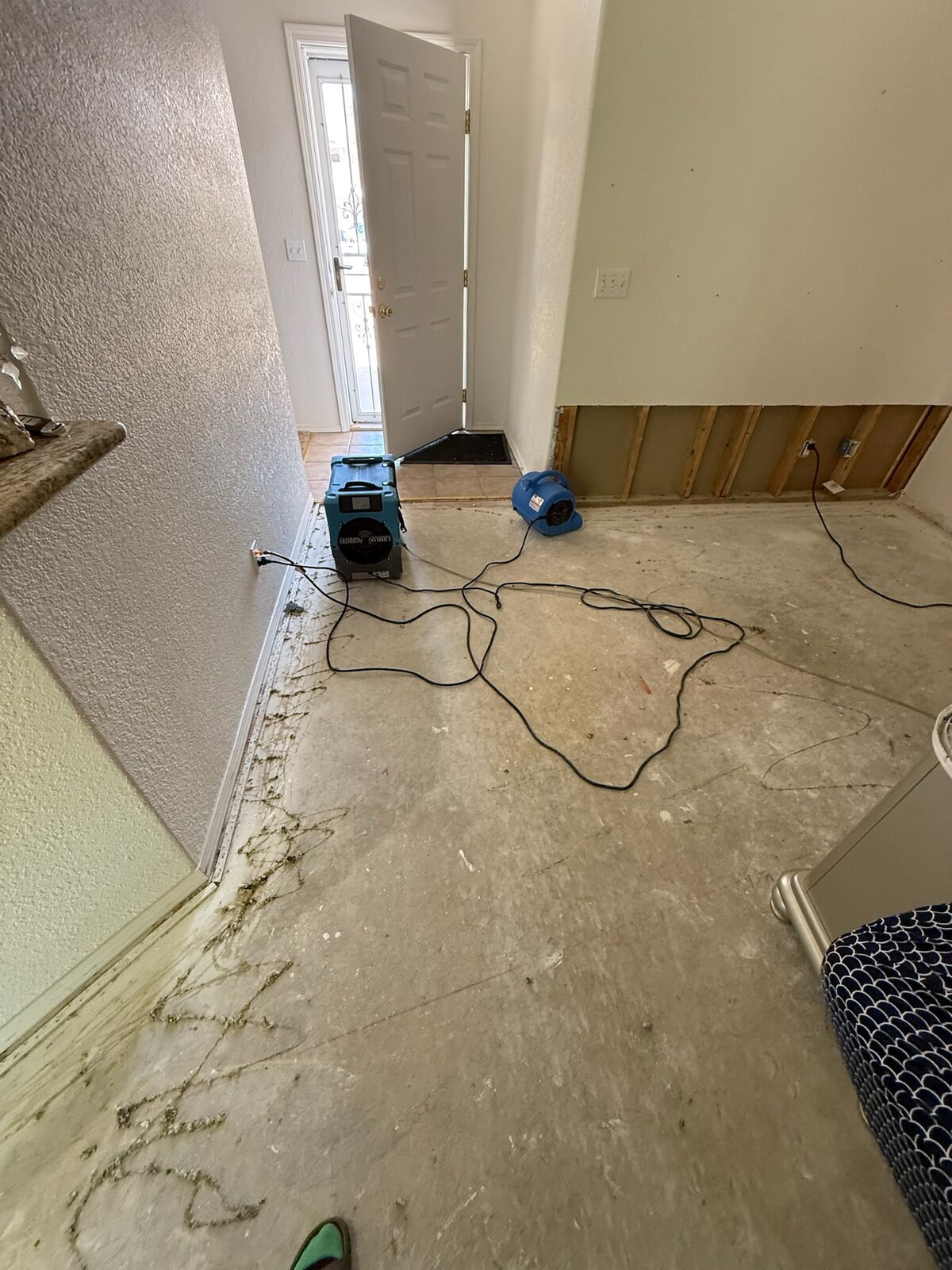
Residential reconstruction work by members of our team. See the full gallery →
More from Gold Water Fire
Fire Damage Restoration in Apache Junction, AZ
Fire and smoke damage restoration for Apache Junction homes, from board-up and soot cleanup through rebuild. Gold Water Fire, AZ ROC #264344. Call (480) 999-3339.
Reconstruction & Rebuild in Apache Junction, AZ
Rebuilding a damaged Apache Junction home after water or fire: framing, drywall, stucco, cabinets and flooring put back by Gold Water Fire. Call (480) 999-3339.
Water Damage Restoration in Apache Junction, AZ
Water damage restoration for Apache Junction homes, from slab leaks and monsoon flooding to failed water heaters. Call Gold Water Fire at (480) 999-3339.
Let someone else read the walls
You have already done the hard part by catching it and stopping it. The rest is measurable, and it is a reasonable thing to hand off. Call Gold Water Fire at (480) 999-3339 or email Help@goldwaterfire.com, and we will come look at your Goodyear home and tell you plainly what is still wet.
Call (480) 999-3339Water Damage Restoration · Fire Damage Restoration · Reconstruction & Rebuild · About Gold Water Fire · Contact Us